ZINGIBERACEAE Lindl. 1835 – HỌ GỪNG
(2 phân họ, 3 tông, 19 chi, 140 loài, 3 thứ)
MỞ ĐẦU
Họ Gừng (Zingiberaceae Lindl.) có khoảng 53 chi, 1300 loài; phân bố ở vùng nhiệt đới và cận nhiệt đới nóng ẩm. Việt Nam có 19 chi với 140 loài và 3 thứ, phân bố ở nhiều vùng trong cả nước. Giá trị tài nguyên của họ Gừng rất quan trọng, chủ yếu làm thuốc chữa bệnh.
Các công trình nghiên cứu về hệ thống phân loại họ Gừng (Zingiberaceae) được bắt đầu từ rất sớm như E. Kaempfer (1690), C. Linnaeus (1753), J. G. Koenig (1767), W. Roscoe (1807), W. Roxburg (1815), C. L. Blume (1823),... Tiếp theo là G. Bentham & J. D. Hooker (1883), J. G. Baker (1894), H. N. Ridley (1899), K. Schumann (1904), R. E. Holttum (1950), B. T. Burtt & R. M. Smith (1972), A. Takhtajan (1996), D. J. Mabblerley (2000),...
Ở Việt Nam cũng sớm có những công trình nghiên cứu về họ Gừng (Zingiberaceae), của tác giả người nước ngoài như J. Loureiro (1790), F. Gagnepain (1908). Bên cạnh đó là các công trình của tác giả Việt Nam ngày càng nhiều và đã bổ sung thêm taxon và thông tin cho hệ Thực vật Việt Nam như Lê Khả Kế (1975), Phạm Hoàng Hộ (1972, 1993, 2000), Trần Văn Ơn (1994), Đào Lan Phương (1995), Nguyễn Quốc Bình (1994), Nguyễn Tiến Bân (1997), Nguyễn Tiến Bân & Nguyễn Quốc Bình (2005),...
Ngoài ra có một số công trình về giá trị tài nguyên của họ Gừng như Võ Văn Chi (1991, 1997), Đỗ Tất Lợi (1995), Lê Trần Đức (1997), Đỗ Huy Bích và cs. (2004),...
Các nước lân cận với Việt Nam cũng có những nghiên cứu về phân loại họ Gừng (Zingiberaceae) như Ấn Độ có J. G. Baker (1894), J. K. Mangaly & M. Sabu (1993); Inđônêxia có C. A. Backer (1968); Trung Quốc có Wu Te-lin (1981, 2002), Tong Shao-quan (1985-1998), Fang Ding (1980); Thái Lan có Kai Larsen (1996),...
Thực vật chí Việt Nam, tập 21 - họ Gừng (Zingiberaceae Lindl.) là công trình phân loại đầy đủ và có hệ thống được biên soạn trên cơ sở hàng chục năm nghiên cứu. Việc điều tra thu thập mẫu vật và tư liệu được tiến hành trên khắp lãnh thổ Việt Nam, đặc biệt các vùng có điều kiện thích hợp cho sự phân bố của loài họ Gừng. Đồng thời đã nghiên cứu tiêu bản và tư liệu ở các phòng tiêu bản trong nước như Viện Sinh thái và Tài nguyên sinh vật (HN); Khoa sinh học Trường Đại học Khoa học Tự nhiên (Đại học Quốc gia Hà Nội) (HNU); Viện Dược liệu (HNPM); Trường Đại học Dược Hà Nội (HNIP); Viện Sinh học Nhiệt đới (HM);... và các phòng tiêu bản ngoài nước như Viện Thực vật Komarov (Liên bang Nga) (LE); Viện Thực vật Côn Minh (Trung Quốc) (KUN); Viện Thực vật Quảng Tây (Trung Quốc) (KBI).
Tập sách dày 492 trang, trình bày những nội dung cho một công trình hệ thống phân loại họ Gừng ở Việt Nam, bao gồm phần giới thiệu đặc điểm hình thái các đại diện ở Việt Nam, kiểm kê các hệ thống phân loại và lựa chọn hệ thống cho nghiên cứu phân loại họ Gừng ở Việt Nam, phần chủ yếu là các khóa định loại taxon. Mỗi taxon được trình bày danh pháp chính thức, các synonym, đặc điểm hình thái, mẫu chuẩn, sinh học và sinh thái, phân bố trong và ngoài nước, mẫu nghiên cứu, giá trị sử dụng, các nhận xét (nếu có).
Bên cạnh đó là 142 hình vẽ chi tiết về đặc điểm hình thái và các loài, có 82 ảnh màu, các bảng tra tên khoa học và Việt Nam, tài liệu tham khảo. Ngoài ra có phần giới thiệu bằng tiếng Anh (gồm mở đầu và các khóa định loại taxon).
Trong công trình còn tham khảo và trích dẫn tư liệu, hình vẽ, ảnh màu của các tác giả khác.
1. ĐẶC ĐIỂM HÌNH THÁI
1.1. THÂN VÀ RỄ (hình 1, 2; ảnh 1)
Họ Gừng (Zingiberaceae) gồm những cây thân thảo sống nhiều năm. Mọc nơi đất ẩm, dưới tán cây gỗ hay tán rừng, hiếm khi phụ sinh (Cautleya gracilis, Hedychium poilanii). Rễ nhỏ, hình sợi, đôi khi đầu rễ phình to lên thành dạng củ (Curcuma, Kaempferia, Stahlianthus,…), ở một số loài, rễ thẳng, cứng, đâm sâu xuống, phần trên lộ ra trên mặt đất (Amomum mengtzense, Hornstedtia sanhan). Thân rễ (thường được gọi là củ) to, nạc, nằm ngang dưới mặt đất, một số ít loài có thân rễ sâu xuống phía dưới, đôi khi trồi lên khỏi mặt đất. Thân rễ chứa nhiều chất dự trữ như ở một số loài trong chi Curcuma. Thân được tạo thành do các bẹ lá ôm chặt lấy nhau tạo thành thân giả, rất ngắn hoặc không có (Distichochlamys, Kaempferia,…) hay cao 1-3 m, đôi khi tới 4-5 m (Alpinia, Amomum,…), thân giả không phân nhánh. Cây thường có mùi thơm hay đôi khi có mùi hắc như một số loài trong chi Zingiber.
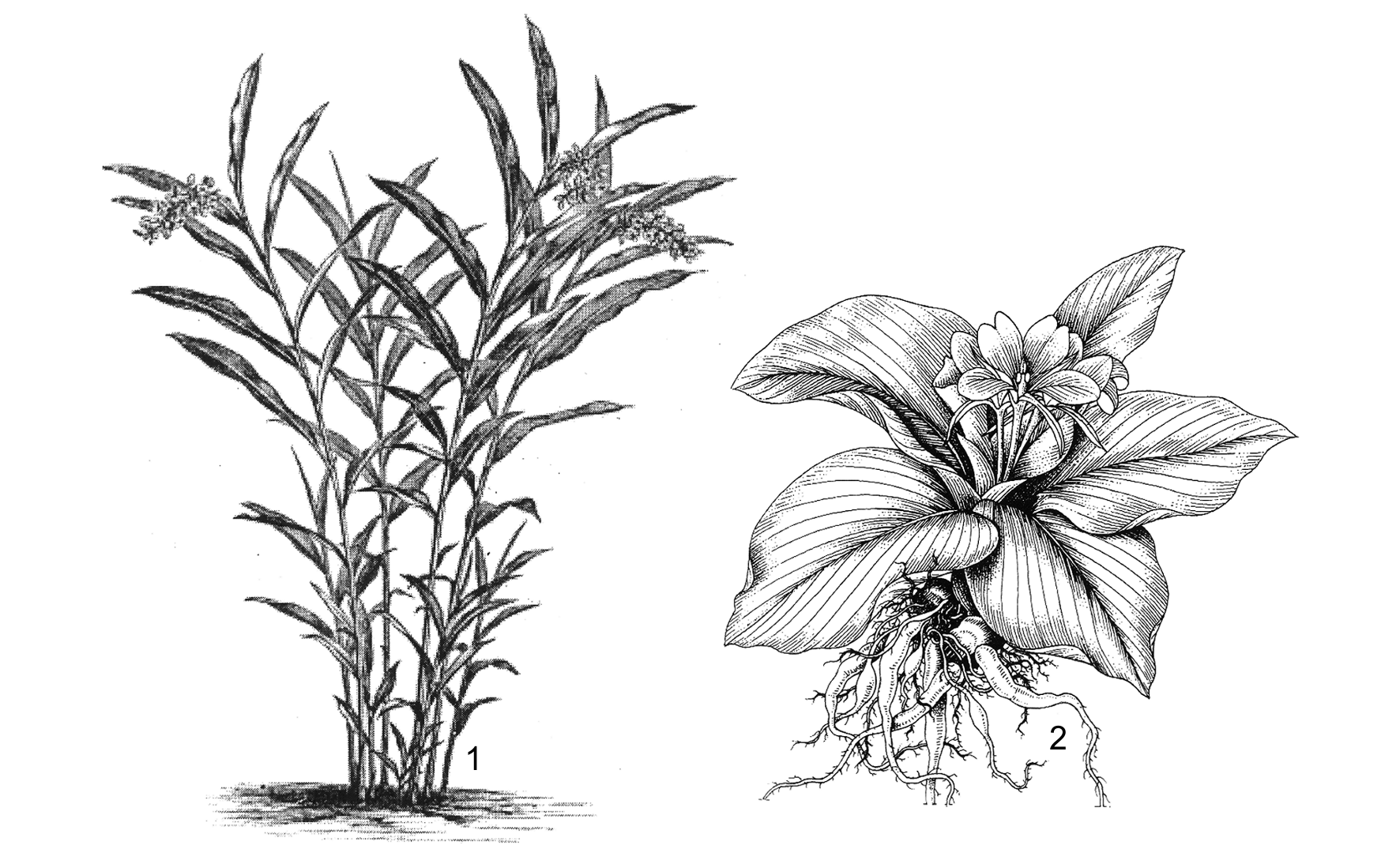
Hình 1. Một số hình thái thân họ Gừng
1. cây có thân giả cao; 2. thân giả rất ngắn hay không có
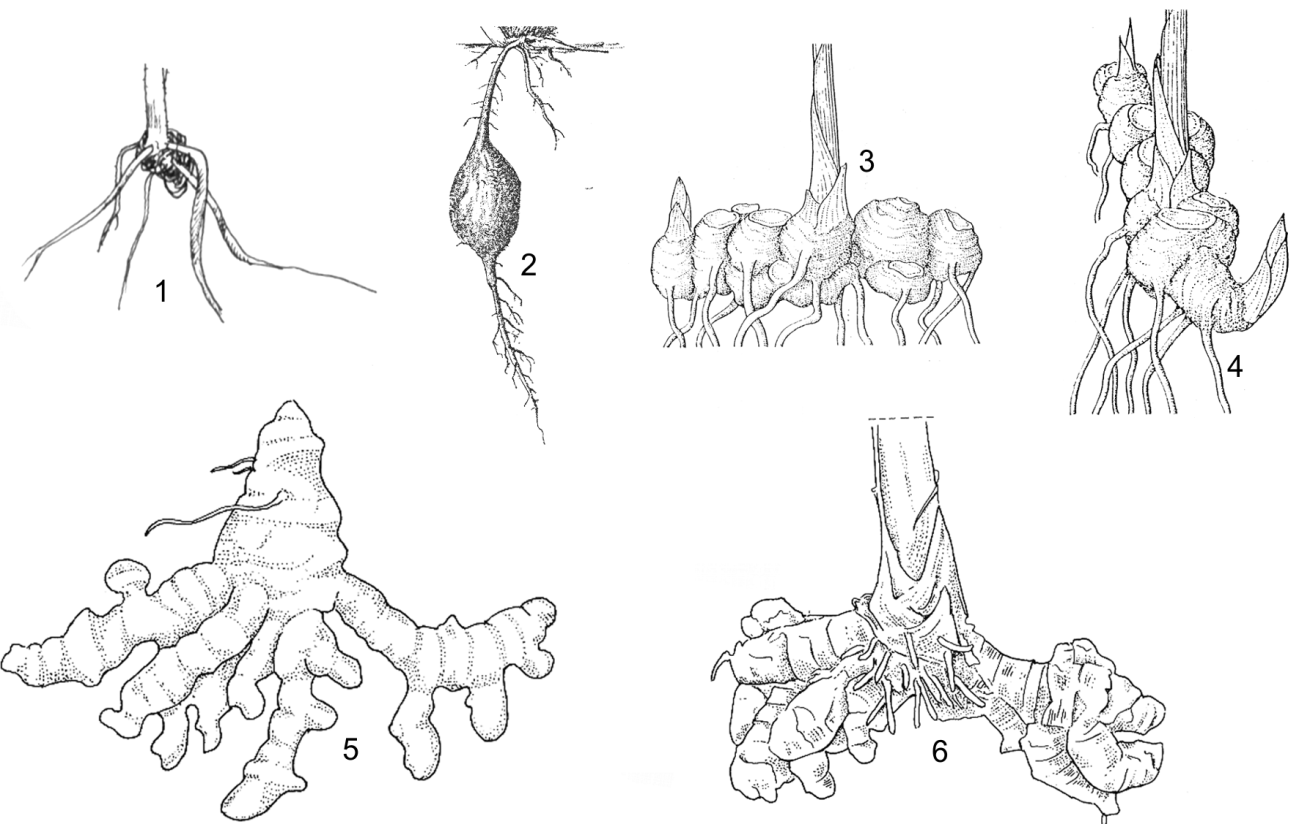
Hình 2. Một số hình thái rễ và thân rễ họ Gừng
1, 2. rễ và đầu rễ phình lên thành dạng củ: 1. Globba rosea; 2. Gagnepainia thoreliana; 3, 4. rễ và thân rễ: 3. Hornstedtia sanhan; 4. Curcuma longa; 5, 6. thân rễ: 5. Zingiber officinale; 6. Curcuma aromatica
1.2. LÁ (ảnh 2, 3)
Lá của các loài họ Gừng là lá đơn, mọc cách, xếp thành hai hàng, thường hướng lên trên, hiếm khi nằm ngang gần như song song với mặt đất (Kaempferia galanga, K. elegans); kích thước và hình thái lá biến đổi, đôi khi phiến lá tiêu giảm, chỉ còn lại bẹ lá hình vảy. Lá gồm các phần: bẹ lá, cuống lá, lưỡi lá và phiến lá.
- Bẹ lá: Ngắn hay dài tùy từng chi, loài. Bẹ lá mở đến gốc ở các loài có thân giả rất ngắn hay không có (Curcuma, Distichochlamys, Kaempferia, Stahlianthus,...). Bẹ lá dính với nhau ở phía gốc thành hình ống, phần trên mở và ôm chặt lấy nhau thành thân giả (hay còn gọi là thân khí sinh) cao đến 4-5 m. Mặt trong bẹ không lông, mặt ngoài có lông hay không, mép có lông dài, ngắn hay không có. Lá xếp thành 2 hàng trên thân khí sinh, mặt trong của bẹ lá, lưỡi lá và mặt trên của phiến lá cùng một hướng, vì vậy các bẹ lá lần lượt ôm lấy nhau theo hướng ngược chiều nhau.
- Cuống lá: Là phần giữa bẹ lá và phiến lá. Cuống lá có tiết diện ngang hình lòng máng nông hoặc sâu. Cuống lá có hay không có tùy từng loài, ngắn hay dài (có thể tới 25 cm). Mặt trong cuống lá không lông, mặt ngoài không hay có lông, mép có lông mi hay không, đôi khi 2 bên mép lá mỏng chất màng.
- Lưỡi lá (thìa lìa): Là phần giữa bẹ lá và cuống lá, từ bẹ lá kéo dài ra. Lưỡi dày hay mỏng chất màng, phía đầu nguyên, cụt ngang hay xẻ thành 2 thùy; đầu lưỡi hay đầu các thùy lưỡi nhọn hay tù; lưỡi dài 1-2 mm hay tới vài cm. Mặt trong lưỡi lá không lông, mặt ngoài có lông hay không, mép có lông mi hay không. Hiếm khi phần tiếp giáp giữa gốc lưỡi lá và phần đầu bẹ lá cong lại giống hình khuỷu (Zingiber).
- Phiến lá: Hình mũi mác, hình trứng hẹp hay hình bầu dục, ít khi gần tròn (Kaempferia elegans); gốc nhọn, hình nêm hay gần tròn; đầu thường nhọn, đôi khi thót nhỏ thành hình đuôi, hiếm khi tròn. Gân chính của lá nổi rõ ở mặt dưới, lõm ở mặt trên, các gân bên xếp hình lông chim, song song với nhau, mép lá nguyên. Phần lớn phiến lá các loài có 2 mặt màu xanh, nhưng ở một vài loài của một số chi, mặt trên có đốm màu trắng loang lổ (Stahlianthus) hay dọc gân chính mặt trên màu nâu đỏ (Curcuma), hoặc mặt dưới màu nâu đỏ (Distichochlamys, Stahlianthus, Zingiber). Hình thái và kích thước phiến lá khác nhau ở các loài khác nhau. Hình thái phiến lá ở mỗi loài giống nhau, nhưng có sự khác nhau về kích thước: những phiến lá dưới cùng ngắn và rộng, dần to và dài hơn về phía giữa, các lá ở giữa có kích thước dài và rộng nhất, rồi giảm dần cho đến những phiến lá trên đầu hẹp hơn. Rõ nét nhất là trong các chi có thân khí sinh cao như trong một số chi Alpinia, Amomum, Hornstedtia,...
1.3. CỤM HOA (hình 3; ảnh 4, 5)
Cụm hoa hình chùy, hình chùm hay hình bông. Cụm hoa mọc ở các vị trí khác nhau tùy theo từng chi:
- Cụm hoa mọc trên ngọn thân khí sinh (thân có lá) (Alpinia, Hedychium, Zingiber,...).
- Cụm hoa mọc từ thân rễ sát mặt đất, riêng với thân có lá (Amomum, Curcuma, Zingiber,...).
- Cụm hoa mọc giữa các bẹ lá (Boesenbergia, Curcuma, Distichochlamys,...).
Đôi khi trong cùng một chi, có loài cụm hoa mọc trên ngọn thân có lá, có loài mọc từ thân rễ (Zingiber), hay từ giữa các bẹ lá và từ thân rễ riêng với thân có lá (Curcuma). Cụm hoa thường xuất hiện sau khi lá đã phát triển đầy đủ, nhưng một số ít loài có cụm hoa xuất hiện trước, lá xuất hiện sau. Những loài này có ở những chi có cụm hoa mọc từ giữa các bẹ lá và mọc từ thân rễ riêng với thân có lá.
Cuống cụm hoa mọc từ thân rễ ở một số chi được bao phủ bởi các bẹ lá hình vảy thưa hay dày, các vảy lợp lên nhau nhiều hay ít, hay không lợp lên nhau. Cuống thường không phân nhánh, trừ một số ít loài trong các chi Globba, Alpinia, Elettaria, Elettariopsis.
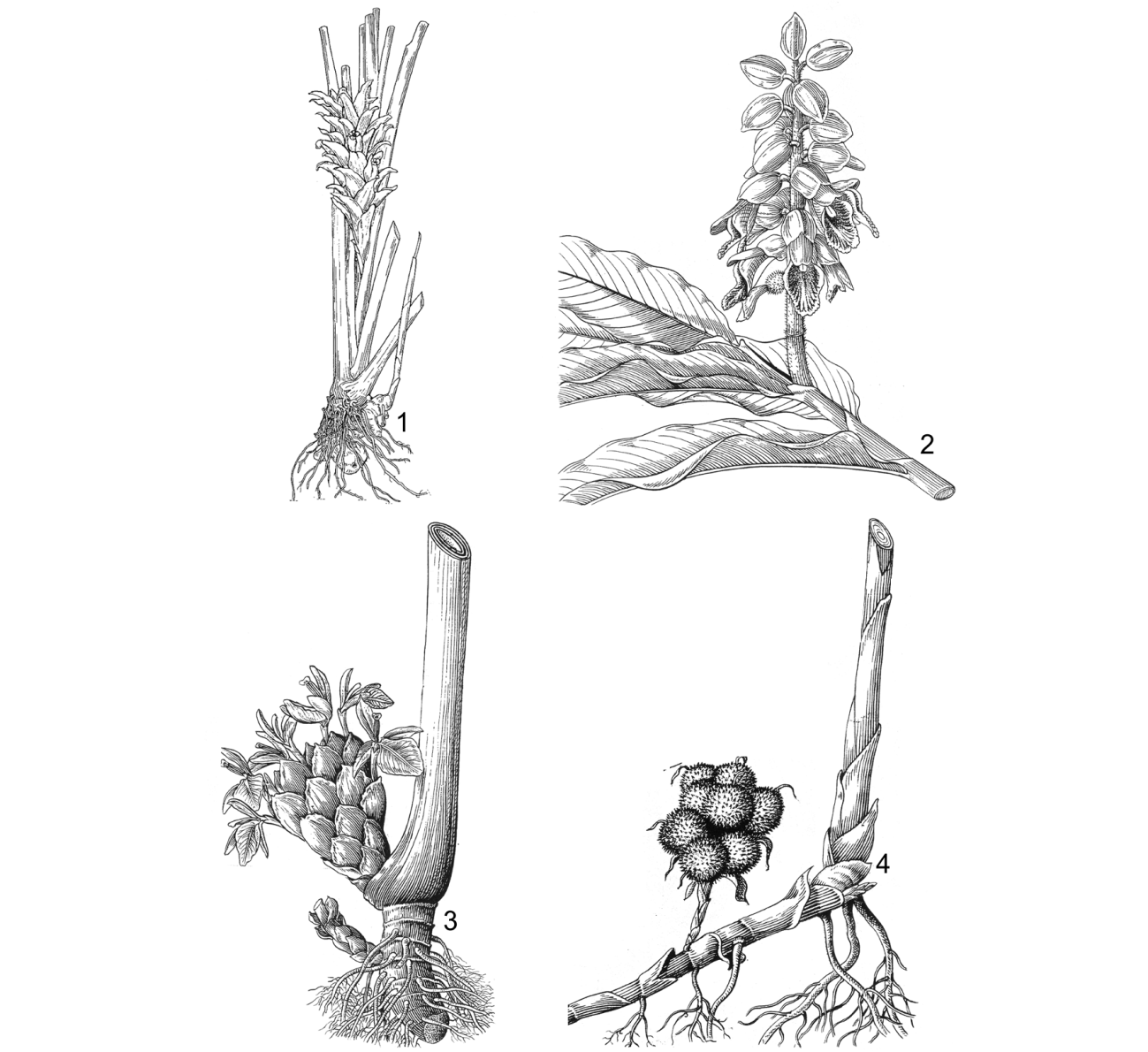
Hình 3. Vị trí và hình thái các cụm hoa quả họ Gừng
1. cụm hoa mọc giữa các bẹ lá: Curcuma kwangsiensis; 2. cụm hoa trên ngọn thân có lá: Alpinia zerumbet; 3, 4. cụm hoa quả mọc riêng với thân có lá: 3. Amomum maximum; 4. Amomum villosum
1.4. LÁ BẮC, LÁ BẮC CON (hình 4, ảnh 6)
- Lá bắc: Lá bắc thường có hình vảy, hình bầu dục, hình mũi mác hay mác-thuôn, bao lấy lá bắc con và hoa, đôi khi lá bắc bao lấy truyền thể (bulbil) (Globba). Các lá bắc dính với nhau ở nửa phía dưới mỗi lá bắc làm thành hình túi (Curcuma), hay hình chuông (Stahlianthus) hoặc xếp lợp lên nhau (Alpinia, Hedychium). Đặc biệt các loài trong chi Curcuma, các lá bắc ở phía dưới hay phía trên của cụm hoa bất thụ (không chứa hoa), thường có màu sắc khác và to hơn lá bắc hữu thụ, hay tất cả là lá bắc hữu thụ (đều chứa hoa). Hiếm khi 1, 2 lá bắc dưới cùng của cụm hoa phát triển rất to bao lấy cả cụm hoa khi non gọi là lá bắc tổng bao (nhưng sớm rụng) (Alpinia). Đôi khi lá bắc không có hoặc sớm rụng.
- Lá bắc con: Nằm trong lá bắc và đính gần sát gốc lá bắc, bao lấy hoa. Lá bắc con dạng vảy hay hình ống, có gốc đính sát với bầu. Đôi khi lá bắc con không có hoặc sớm rụng.
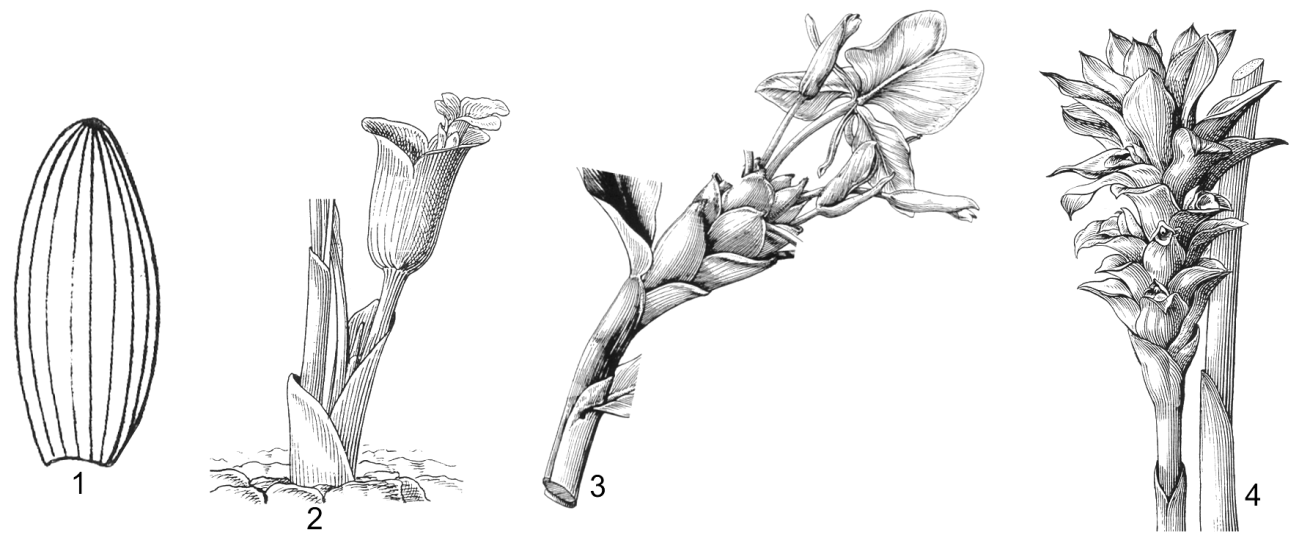
Hình 4. Một số hình thái lá bắc con và các lá bắc họ Gừng
1. lá bắc: Alpinia calcicola; 2. lá bắc hình chuông: Stahlianthus campanulatus; 3. lá bắc lợp lên nhau: Hedychium coronarium; 4. lá bắc dính với nhau thành hình túi: Curcuma longa
1.5. HOA (hình 5-8)
Hoa lưỡng tính, mẫu 3, bầu hạ, đối xứng hai bên, có màu sắc, kích thước trung bình hoặc lớn. Bộ phận hoa của phần lớn các loài tạo thành hình ống, phía trong có ít mật để dẫn dụ côn trùng. Các hoa đính trên cụm hoa dày đặc hay thưa thớt, đơn độc hay vài hoa trong một cụm nhỏ (cincinnus) đính vào trục cụm hoa. Mỗi hoa thường chỉ nở và tàn trong một ngày. Hoa gồm các bộ phận:
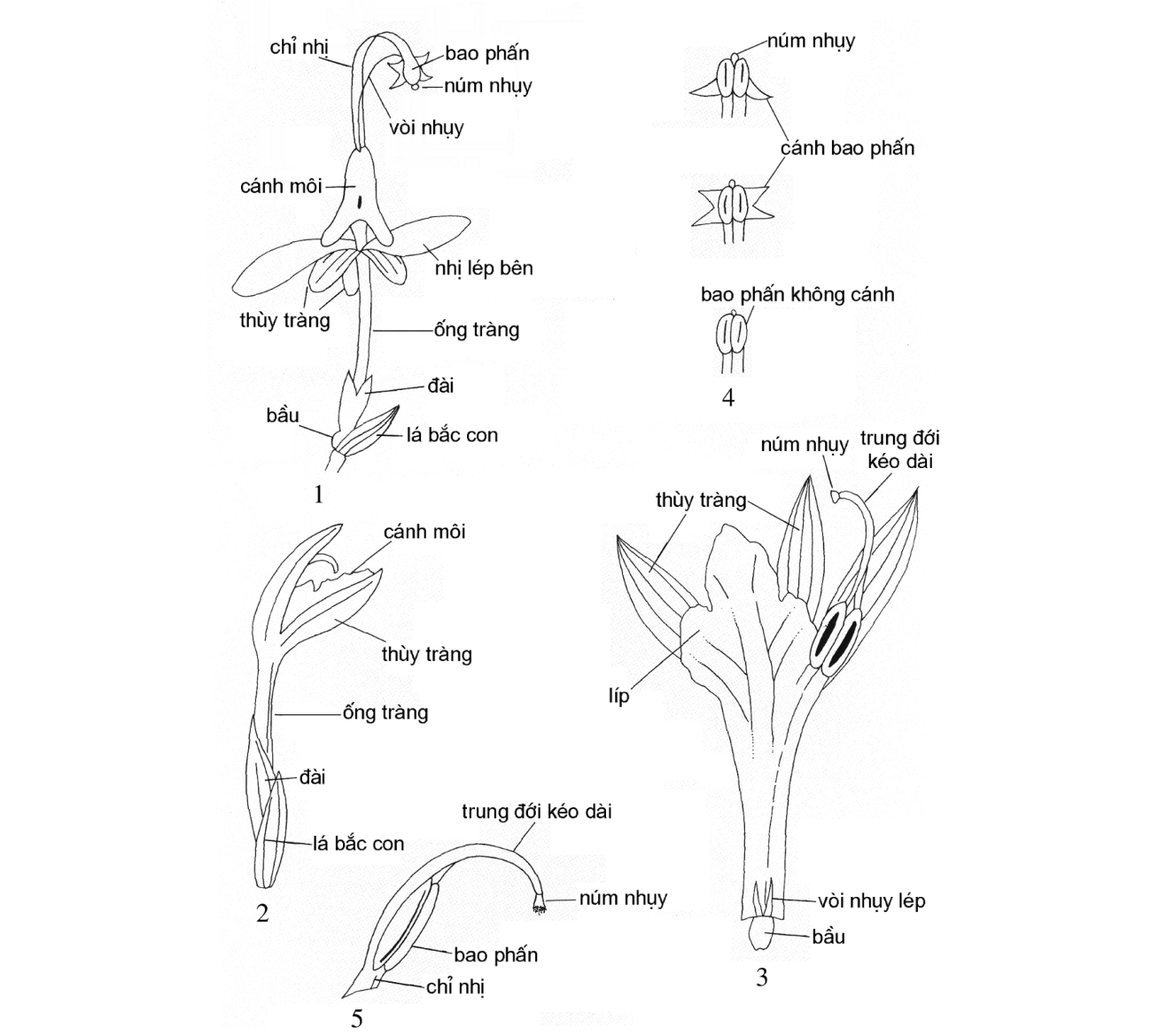
Hình 5. Sơ đồ một số kiểu hoa và bao phấn họ Gừng
1-3. một số kiểu hoa: 1. Globbeae; 2, 3. Zingiber; 4, 5. bao phấn: 4. Globbeae; 5. Zingiber
- Đài: Các lá đài dính với nhau ở phần dưới thành hình ống, hình trụ, hình phễu hay hình chuông. Phần trên chia 2-3 thùy ngắn hay dài giống như hình răng hay xẻ sâu 1 bên thành hình chữ V, đầu trên chia 2-3 thùy.
- Tràng: Dính với nhau ở phần dưới thành hình ống mảnh, hình phễu hẹp, hình phễu hay hình chuông, đôi khi phình rộng ở giữa, thường dài hơn đài; phần trên chia 3 thùy; thùy lưng thường to hơn 2 thùy bên, lõm, đầu thùy lưng lõm ít hay nhiều thành dạng mũ (Alpinia, Globba).
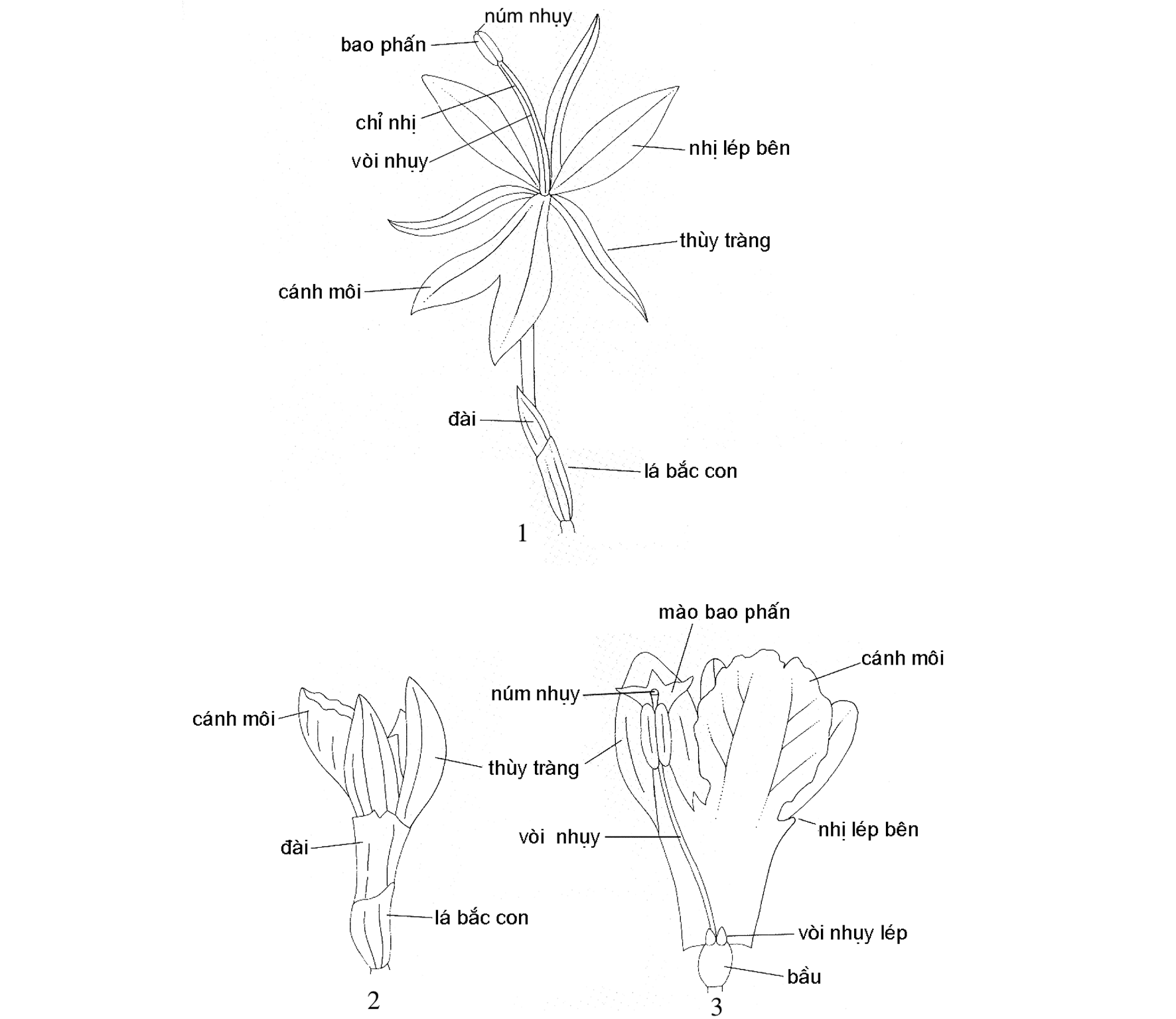
Hình 6. Sơ đồ một số kiểu hoa họ Gừng
1, 2. kiểu hoa: 1. Hedychium; 2. Amomum; 3. hoa đã mở đài và tràng: Amomum
- Bộ nhị: Chỉ có một nhị hữu thụ duy nhất (nhị sinh sản) và 5 nhị bất thụ. Nhị hữu thụ nằm ngay phía trong thùy tràng lưng, gồm có chỉ nhị và 2 bao phấn. Chỉ nhị hình bản mỏng hay dày, ngắn hoặc dài, phía trên đính hai ô bao phấn hướng trong (hình 7, ảnh 8), các ô bao phấn song song hay gần song song với nhau, đôi khi chụm ở phía đầu thành hình mũi tên (Hedychium villosum) hay chụm ở dưới thành dạng hình chữ V. Ô bao phấn mở bằng khe dài dọc theo ô bao phấn. Phần nối lưng 2 ô bao phấn với nhau gọi là trung đới, trung đới có hay không có phần phụ, nếu có thì có các hình thái sau:
+ Kéo dài lên phía trên tạo thành mào, không bao lấy vòi nhụy, xẻ 2-3 thùy hay nguyên.
+ Kéo dài rồi nhỏ dần, 2 mép cuộn vào nhau giống như hình vòi bao lấy vòi nhụy kéo dài (Zingiber).
+ Kéo dài ở 2 phía cạnh ngoài các bao phấn thành hình cánh (Globba).
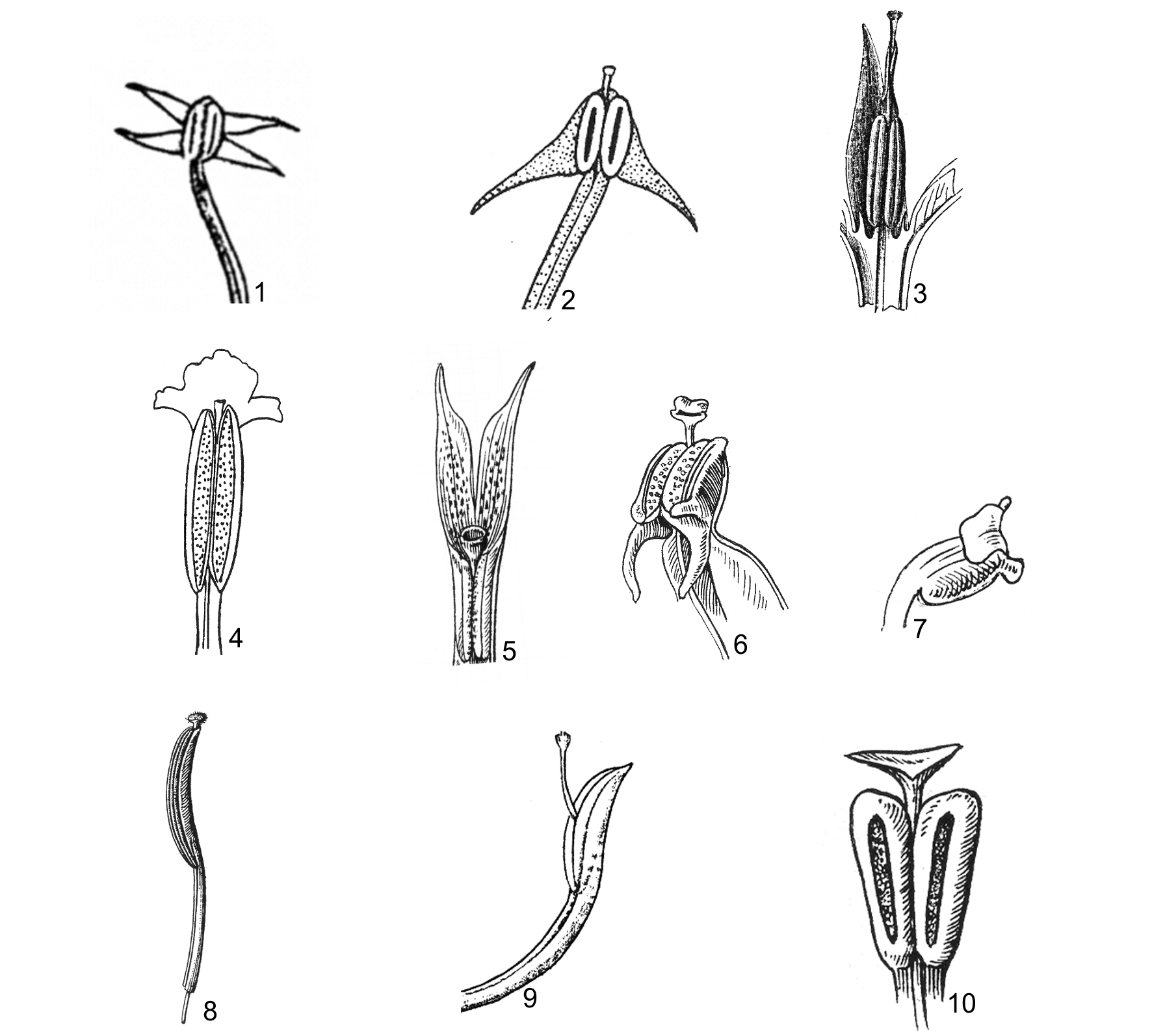
Hình 7. Một số hình thái bao phấn và các phần phụ trung đới họ Gừng
1, 2. bao phấn và phần phụ trung đới hình cánh: 1. Globba macrocarpa; 2. Globba pendula; 3. bao phấn và phần phụ trung đới kéo dài bao lấy đầu nhụy: Zingiber officinale; 4-7. bao phấn và phần phụ bao phấn hình mào, cựa bao phấn: 4. Amomum tomrey; 5. Kaempferia rotunda; 6. Curcuma thorelii; 7. Amomum longiligulare; 8-10. bao phấn không có phần phụ: 8. Hedychium coronarium; 9. Hedychium ellipticum; 10. Alpinia siamensis
Trường hợp trung đới bao phấn không có phần phụ, nhưng ở gốc mỗi bao phấn kéo dài xuống phía dưới tạo thành cựa (Curcuma). Cánh môi (hình 8, ảnh 7) đối diện với nhị, do 3 nhị bất thụ dính lại với nhau biến thành, kích thước to hay nhỏ, có màu sặc sỡ. Đầu cánh môi nguyên hay xẻ thành 2-3 thùy, mép cánh môi lượn sóng hay không. Hai nhị bất thụ còn lại (thường được gọi là nhị lép bên) nằm ở hai bên gốc cánh môi, phát triển thành hình cánh tràng không dính với cánh môi (Distichochlamys, Hedychium,...), hay dính với cánh môi ở phía dưới gốc (Zingiber), hoặc tiêu giảm thành hình răng hay hình vảy, hay tiêu giảm hoàn toàn (Alpinia, Amomum,...).
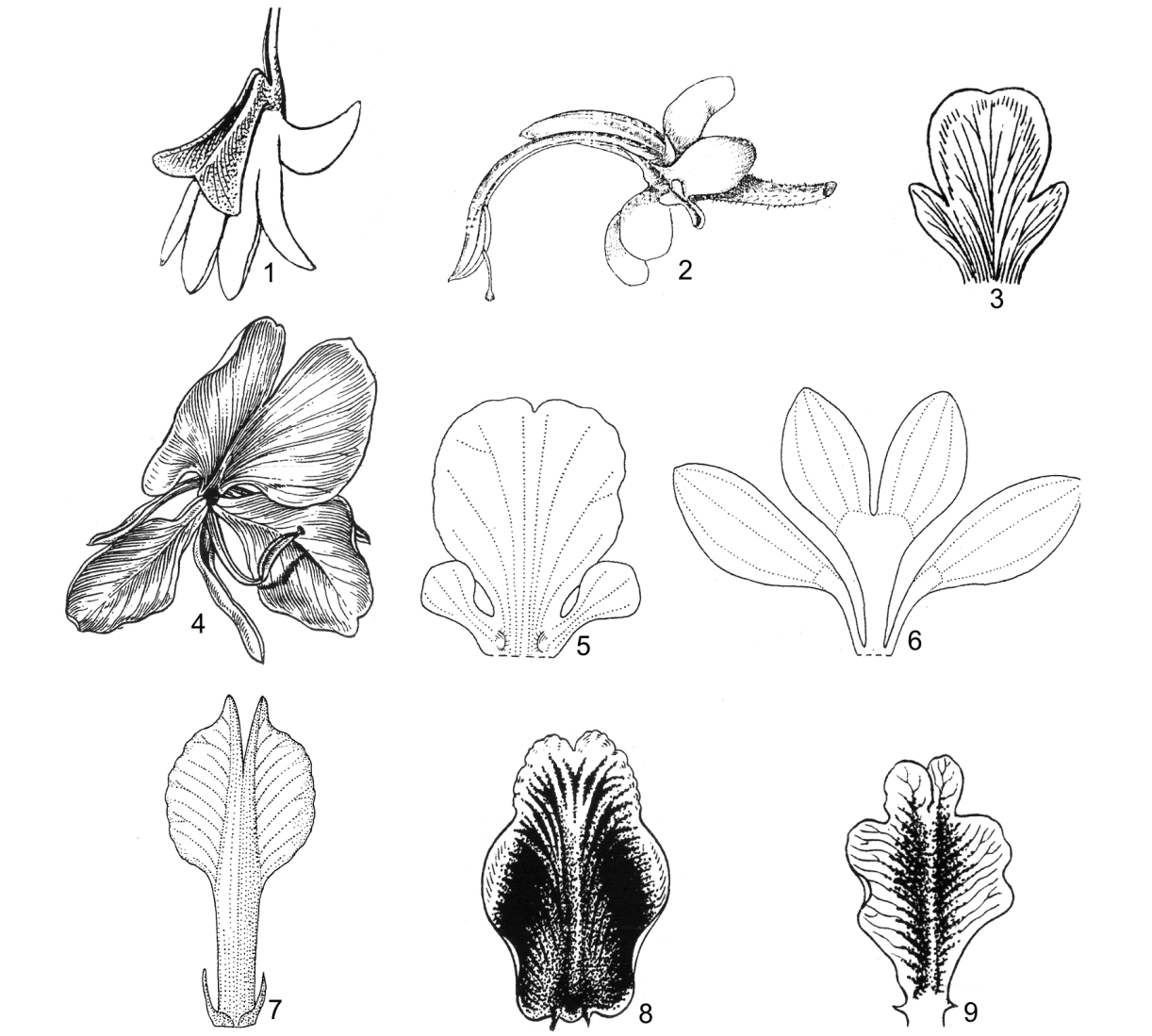
Hình 8. Một số hình thái cánh môi và nhị lép bên họ Gừng
1. Globba barthei; 2. Gagnepainia thoreliana; 3. Zingiber officinale; 4. Hedychium coronarium; 5. Caulokaempferia petelotii; 6. Kaempferia galanga; 7. Alpinia galanga; 8. Alpinia zerumbet; 9. Amomum muricarpum
- Bộ nhụy: Bộ nhụy hợp nguyên lá noãn (syncarpous) hay hợp bên lá noãn (paracarpous). Bầu hình tròn, bầu dục, hình trụ, đôi khi hình phễu; 3 ô hay 1 ô, hiếm khi cả 3 ô và 1 ô trong 1 bầu (Siliquamomum tonkinense), noãn đảo, nhiều; đính noãn trụ giữa hay đính noãn bên. Một vòi nhụy mảnh, nằm dọc theo rãnh phía trong chỉ nhị, qua khe giữa 2 bao phấn và trung đới; núm nhụy thường loe hình phễu nhô lên phía trên đầu 2 bao phấn; riêng chi Zingiber, vòi nhụy kéo dài vượt quá đầu 2 bao phấn và được phần phụ trung đới của bao phấn kéo dài bao lấy, núm nhụy do vậy cũng cao hơn, núm nhụy có lông mi hay không. Ngoài 1 nhụy hữu thụ duy nhất, còn có 2 vòi nhụy lép hình dùi hay bản ngắn, đính trên đỉnh bầu, trong gốc đài, tràng.
1.6. QUẢ, HẠT (hình 9, ảnh 9)
- Quả: Quả nang chẻ ô; quả có lông hay không và có nhiều dạng khác nhau:
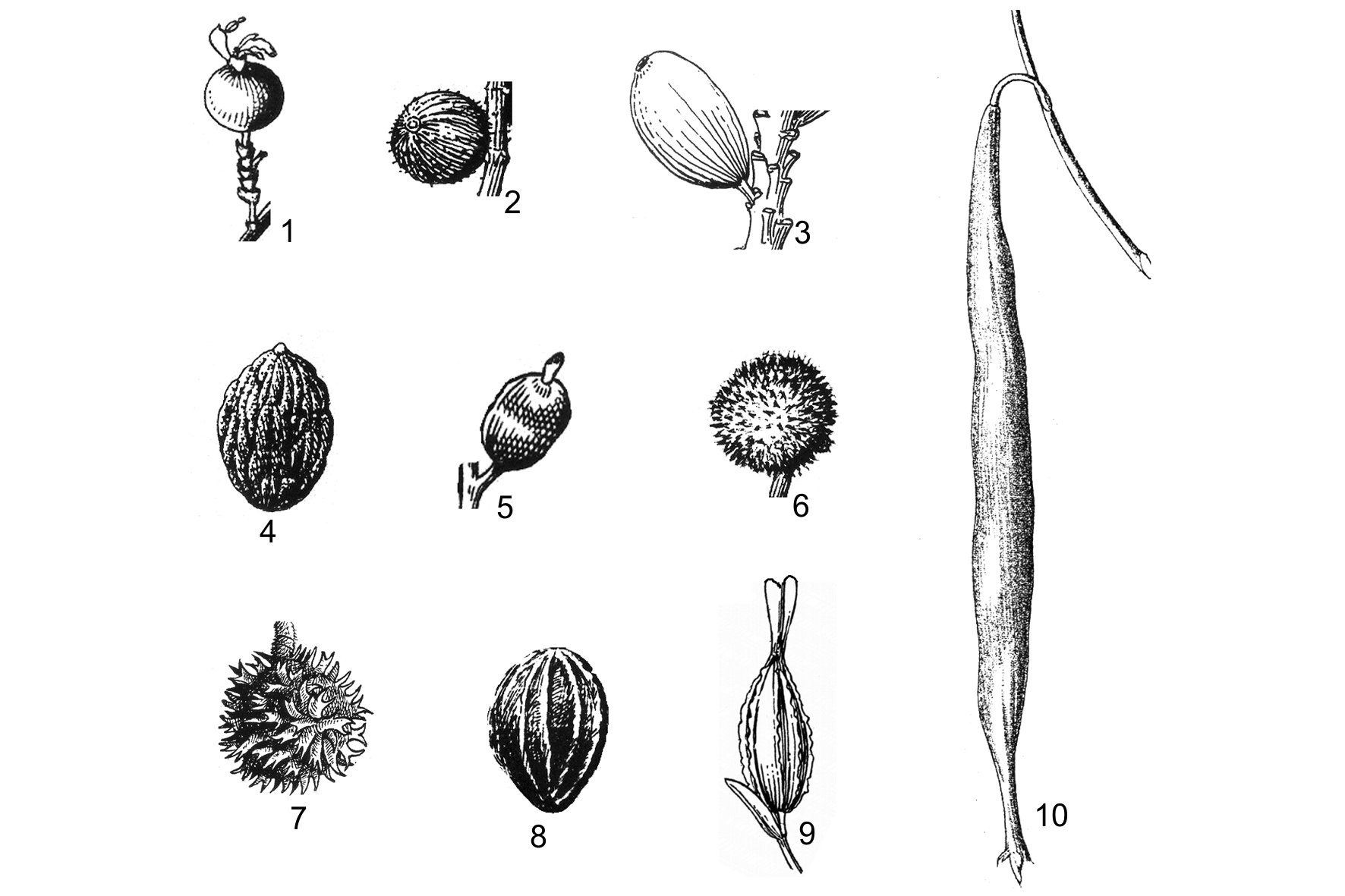
Hình 9. Một số hình thái quả họ Gừng
1, 2. quả hình cầu: 1. Alpinia conchigera; 2. Alpinia officinarum; 3, 4. quả hình bầu dục: 3. Amomum aromaticum; 4. Alpinia oxyphylla; 5. quả có ngấn giữa: Alpinia galanga; 6. quả có gai mềm không phân nhánh: Amomum villosum; 7. quả có gai mềm phân nhánh: Amomum muricarpum; 8, 9. quả có cánh: 8. Amomum maximum; 9. Amomum mengtzense; 10. quả giác: Siliquamomum tonkinense
+ Hình tròn hay bầu dục, đường kính từ 0,3-0,4 cm đến 2-3(4) cm, hiếm khi quả hình bầu dục có ngấn giữa (Alpinia galanga).
+ Hình thoi (Alpinia oxymitra) hay hình trứng hẹp (Amomum mengtzense), quả giác (quả cải) có chiều dài tới hơn 20 cm, trong khi đường kính chỗ rộng nhất chỉ 1-2 cm (Siliquamomum tonkinense, S. oreodoxa).
+ Có gờ nổi theo chiều dọc (Alpinia, Amomum, Elettaria, Elettariopsis).
+ Trơn hay có lông, có gai mềm, gai mềm phân nhánh hay không (Alpinia, Amomum).
+ Có cánh hình quả khế (Amomum).
Ở một số chi như Curcuma, Stahlianthus,… hiếm gặp quả.
- Hạt: Hình bầu dục hay gần tròn hay có góc cạnh; màu đỏ, màu đen, nâu hay màu xám; có áo hạt mềm màu đen, trắng, hay đôi khi có màu đỏ; áo hạt rách không đều.
Typus: Zingiber Boehm.
2. PHÂN BỐ VÀ SINH THÁI
Nhiều loài họ Gừng phân bố ở vùng nhiệt đới và cận nhiệt đới châu Á (Amomum, Hornstedtia, Etlingera, Zingiber, Curcuma, Hedychium, Caulokaempferia, Boesenbergia, Globba, Kaempferia,...); một số loài sống ở Ôxtrâylia và các quần đảo ở Thái Bình Dương (Alpinia, Amomum, Curcuma, Globba,...); một số loài ở vùng Đông Nam Á (Alpinia, Amomum, Geostachys, Elettaria, Elettariopsis, Cautleya, Gagnepainia,...); một số sống ở Ấn Độ, Trung Quốc (Siliquamomum, Elettaria, Elettariopsia, Caulokaempferia, Cautleya, Kaempferia,...); một số ở Nam Mỹ (Elettaria), châu Phi (Hedychium, Kaempferia,...). Các đại diện của họ Gừng hầu hết ưa bóng, sống dưới tán rừng ẩm, trong nương rẫy, ven suối nơi đất giàu dinh dưỡng, thoát nước; còn được trồng quanh làng xóm hay trong rừng.
3. GIÁ TRỊ TÀI NGUYÊN
Giá trị khoa học: Chi Distichochlamys với 3 loài và 21 loài (thuộc 11 chi khác) được coi là những taxon đặc hữu của Việt Nam.
Giá trị sử dụng: có khoảng 64 loài thuộc 11 chi (45 % số loài và 73 % số chi) có giá trị sử dụng như: làm thuốc (57 loài) chủ yếu ở các chi Amomum, Alpinia, Curcuma, Zingiber,...; làm gia vị (17 loài); cho tinh dầu (38 loài); làm cảnh (10 loài); rau ăn (9 loài); thuốc nhuộm (16 loài); cho sợi (2 loài); men rượu (3 loài); làm giấy; cho tinh bột;.... Một số chi có nhiều loài giá trị sử dụng cao như Alpinia, Amomum, Curcuma, Zingiber.
4. HỆ THỐNG PHÂN LOẠI HỌ GỪNG (ZINGIBERACEAE Lindl.)
4.1. Một số hệ thống phân loại họ Gừng trên thế giới
Người đầu tiên thu thập các mẫu của họ Gừng là một bác sĩ người Đức, đó là Engelbert Kaempfer, ông đã điều tra thu mẫu Thái Lan năm 1690. Nhưng năm 1753, C. Lineaeus chỉ chọn ra 2 loài trong bộ sưu tập của Kaempfer và đặt tên là Kaempferia galanga và Kaempferia rotunda. Cùng với các chi khác của họ Gừng đã được C. Linnaeus (1753) mô tả là Amomum, Alpinia, Curcuma và Costus với tổng số là 10 loài.
J. G. Koenig, một bác sĩ y khoa ở Trankebar thuộc Ấn Độ, một thuộc địa của Đan Mạch vào năm 1767, nơi tác giả đã thu thập một số lượng khá lớn các mẫu thuộc họ Gừng. Năm 1779, tác giả ở Thái Lan (Phuket) và năm 1781 ở Ceylon. Tác giả là một trong những nhà thu thập các mẫu thuộc họ Gừng quan trọng nhất của thế kỷ XVIII, mặc dù rất ít những nghiên cứu được công bố. Tác giả đã mô tả 21 loài họ Gừng trên cơ sở các mẫu cây sống và đã được công bố năm 1783, trong đó có 4 chi mới là Hura (Globba), Languas (Alpinia), Hedychium và Banksea (Costus).
Đầu thế kỷ XIX, nhà viết sử người Anh, sau trở thành nhà nghiên cứu thực vật và là người sáng lập ra Vườn Thực vật Liverpool (Anh) là William Roscoe (1807), đã nghiên cứu 66 loài họ Gừng, phần lớn được trồng ở Vườn Thực vật Liverpool. Trong thời gian từ năm 1824-1828, ông đã công bố các nghiên cứu của mình trong công trình Monandrian plants of the order Scitamineae và đã phát hành 150 số với 112 hình vẽ in đá.
Một công trình nghiên cứu không kém phần quan trọng là của William Roxburgh (1815) đã mô tả 47 loài trong 8 chi của họ Gừng ở Ấn Độ, phần lớn các loài này được minh họa bằng hình vẽ. Trong thế kỷ XIX, nhiều nhà phân loại thực vật về họ Gừng đã theo hệ thống của Roxburgh, sử dụng tên các loài trong các chi Amomum và Alpinia.
C. L. Blume (1823) đã có công trình về họ Gừng trên cơ sở bản thảo của Reinwardt với những mô tả ngắn và đặc trưng của rất nhiều loài tự nhiên ở vùng thuộc địa của Hà Lan. Danh mục này có ghi 20 loài và 8 chi ở Buitenzorg (Bogor, Inđônêxia ngày nay). Còn danh lục năm 1827 ghi nhận 57 loài và 12 chi có ở Java (Inđônêxia). Nhưng tiếc rằng, danh pháp của nhiều loài không đầy đủ để được công nhận theo luật danh pháp quốc tế. Trong các công trình, Blume đã cố gắng chia nhỏ họ Gừng thành các nhóm có quan hệ với nhau, giống như các tông của Meisner (1842) sau này.
Năm 1883, G. Bentham & J. D. Hooker đã xếp các họ thực vật được trích dẫn từ công trình của Horaninow (1862): Musaceae, Zingiberaceae, Marantaceae và Cannae chuyển thành các taxon cùng bậc tông trong một nhóm chung gọi là “Scitamineae”. Như vậy các chi trong họ Gừng được xếp vào trong 1 tông, gọi là Tribus 1 - Zingibereae. Trong công trình này, các tác giả đã chia tông Zingibereae thành 2 nhóm. (bảng 1):
Bảng 1. HỆ THỐNG PHÂN LOẠI HỌ ZINGIBERACEAE CỦA G. BENTHAM & J. D. HOORKER (1883)
|
Trib. Zingibereae
|
|
1. Nhóm bầu 1 ô
|
Gen. Globba
Guillaimia
Hemiorchis
Mantisia
|
|
2. Nhóm bầu 3 ô
|
Gen. Alpinia
Amomum
Burbidgea
Costus
Curcuma
Cyphostigma
Elettaria
Gastrochilus
Hedychium
Hitchenia
Kaempferia
Leptosolena
Renealmia
Roscoea
Tapeinochilus
Zingiber
|
- Nhóm bầu 1 ô, noãn đính vách, gồm có 4 chi.
- Nhóm bầu 3 ô, noãn đính trụ giữa, gồm có 16 chi.
Từ việc phân chia thành các nhóm dựa vào số lượng ô trong bầu như trên, hệ thống của G. Bentham & J. D. Hooker (1883) đã đặt tiền đề cho việc sắp xếp các taxon lớn trong họ Gừng về sau này. Tuy nhiên, tác giả mới dừng ở mức độ mô tả đặc điểm của các chi, ghi nhận số lượng loài, phân bố địa lý, chưa đi sâu mô tả đặc điểm các loài. Mặc dù vậy, hệ thống cũng đã được các nhà nghiên cứu họ Gừng sử dụng trong một thời gian dài.
Cũng căn cứ vào đặc điểm số lượng ô của bầu, J. G. Baker (1894) đã chia họ Gừng ở Ấn Độ thành 2 nhóm lớn, nhưng vẫn để tất cả các chi trong bậc tông. Đáng chú ý là tác giả đã dựa vào vị trí và hình thái cụm hoa, các đặc điểm hình thái của hoa như mào, cựa hay cánh của bao phấn,… để chia taxon bậc chi thành những bậc phân loại nhỏ hơn, như phân chi (Subgenus), tổ (Section). Trong công trình này, rất nhiều loài mới đã được công bố, nhưng mô tả của các loài rất vắn tắt.
H. N. Ridley (1899) đã gọi họ Gừng là một nhóm với tên Zingiberaceae, cách gọi phù hợp với luật danh pháp hiện hành. Trong đó, tác giả đã căn cứ vào đặc điểm của nhị lép bên: nhị lép bên rộng và dạng cánh tràng đối lập với nhị lép bên nhỏ hay không có, dính với cánh môi, để chia các chi trong họ thành 2 nhóm lớn, như bảng 2 sau:
Bảng 2. HỆ THỐNG PHÂN LOẠI HỌ ZINGIBERACEAE CỦA H. N. RIDLEY (1899)
|
Nhị lép bên rộng
và dạng cánh tràng
|
Nhị lép bên nhỏ hay không có
dính với cánh môi
|
|
Camptandra
|
Alpinia
|
|
Conamomum
|
Amomum
|
|
Curcuma
|
Costus
|
|
Gastrochilus
|
Elettariopsis
|
|
Globba
|
Geostachys
|
|
Hedychium
|
Hornstedtia
|
|
Kaempferia
|
Plagiostachys
|
|
|
Zingiber
|
Đặc điểm này không thể hiện sự đối lập rõ ràng nếu so với quan điểm của G. Bentham & J. D. Hooker là dựa vào số lượng ô của bầu để chia các chi họ Gừng thành các nhóm lớn. Mặt khác, nhị lép trong chi Zingiber là hình cánh tràng (giống như thùy) và dính với cánh môi, nhưng tác giả lại xếp vào nhóm nhị lép bên nhỏ hay không có. Các đặc điểm phân chia các nhóm của H. N. Ridley về sau cũng được nhiều nhà nghiên cứu họ Gừng sử dụng nhưng với những bậc phân loại thấp hơn.
Đáng chú ý nhất là công trình nghiên cứu khá toàn diện và có hệ thống của K. Schumann vào đầu thế kỷ XX (1904), được gọi là Hệ thống Engler, vì ông đã đặt nền móng cho công trình đồ sộ này. Trong đó ghi nhận hơn 800 loài họ Gừng với 38 chi, gồm cả 4 chi thuộc họ Mía dò (Costaceae) sau này. Với một nửa số loài do K. Schumann mô tả và công bố mới. Dựa trên các đặc điểm hình thái, tác giả đã tìm hiểu mối quan hệ thân cận giữa các taxon và dựa vào các đặc điểm của hoa để chia các taxon thành những bậc phân loại khác nhau, sắp xếp chúng theo mức độ tiến hóa từ thấp lên cao. Việc sử dụng các loạt đặc điểm trong phân loại họ Gừng đã làm cho việc phân định các taxon có cơ sở vững chắc hơn, đây là điều rất thuận lợi cho các nghiên cứu về sau. Trong công trình, tác giả chia họ Gừng thành 2 phân họ (Subfamily): Costoideae và Zingiberoideae. (bảng 3).
Bảng 3. HỆ THỐNG PHÂN LOẠI HỌ ZINGIBERACEAE CỦA K. SCHUMANN (1904)
|
Subfam.1. Costoideae
|
Subfam.2. Zingiberoideae
|
|
Trib.1. Costeae
|
Trib.2. Globbeae
|
Trib.3. Zingibereae
|
Trib.4. Hedychieae
|
|
Costus
|
Hemiorchis
|
Zingiber
|
Hedychium
|
|
Dimerocostus
|
Gagnepainia
|
Hornstedtia
|
Odontychium
|
|
Monocostus
|
Globba
|
Aframomum
|
Brachychilus
|
|
Tapeinochilus
|
Mantisia
|
Amomum
|
Conamomum
|
|
|
|
Phaeomeria
|
Camptandra
|
|
|
|
Elettaria
|
Kaempferia
|
|
|
|
Cyphostigma
|
Haplochorema
|
|
|
|
Autotandra
|
Gastrochilus
|
|
|
|
Geostachys
|
Hitchenia
|
|
|
|
Pommereschea
|
Siliquamomum
|
|
|
|
Burbidgea
|
Curcuma
|
|
|
|
Renealmia
|
Roscoea
|
|
|
|
Alpinia
|
Cautleya
|
|
|
|
Riedelia
|
|
|
|
|
Plagiostachys
|
|
|
|
|
Nanochylus
|
|
|
|
|
Rhynchanthus
|
|
Subfam.1. Costoideae
Đặc điểm: lá xếp xoắn, bẹ lá hình ống; không có nhị lép bên; lá không có mùi thơm. Có 1 tông là:
Trib.1. Costeae
Subfam.2. Zingiberoideae
Đặc điểm: lá xếp thành 2 hàng, bẹ lá mở một bên; nhị lép bên thường dạng cánh tràng hay tiêu giảm thành dạng răng hay không có; lá có mùi thơm. Phân họ này được chia thành 3 tông là:
Trib.2. Globbeae: bầu 1 ô, noãn đính vách.
Trib.3. Zingibereae: bầu 3 ô, noãn đính trụ giữa; nhị lép bên nếu dạng cánh tràng thì dính với cánh môi ở gốc, nếu tiêu giảm thành dạng răng thì không dính với cánh môi (hiếm khi dính với cánh môi).
Trib.4. Hedychieae: bầu 3 ô, noãn đính trụ giữa; nhị lép bên dạng cánh tràng, không dính với cánh môi.
So với hệ thống G. Bentham & J. D. Hooker, K. Schumann (1904) đã phân chia các bậc taxon cơ bản rõ ràng, từ phân họ (Subfamily), tông (Tribus), đến chi (Genus), loài (Species). Taxon bậc chi lại được chia thành các bậc nhỏ hơn như phân chi (Subgenus), tổ (Section), loạt (Series). Đây chính là tính ưu việt nổi bật vì phần lớn các hệ thống trước đó chỉ chú ý đến bậc tông và chi. Điều này rất có ý nghĩa trong việc phân định các taxon, đồng thời cũng chỉ rõ mối quan hệ giữa các taxon với nhau. Danh pháp của phần lớn các bậc trong họ cũng như việc công bố loài mới được trình bày phù hợp với luật danh pháp quốc tế về thực vật hiện hành. Nhìn chung, hệ thống của K. Schumann là khá hoàn chỉnh, đã đánh dấu một bước tiến rất quan trọng trong lịch sử nghiên cứu họ Gừng, bởi vậy nhiều công trình nghiên cứu họ Gừng sau này đã sử dụng hệ thống này trên cơ sở sử dụng các đặc điểm mà K. Schumann đã lựa chọn. Mặc dù vậy, trong hệ thống, K. Schumann vẫn công nhận Costeae là 1 tông trong họ Gừng, trong đó danh pháp một số taxon không còn thích hợp.
Sau K. Schumann, cũng có một số hệ thống phân loại họ Gừng như T. Valeton (1913), T. Loesener, (1930), J. Hutchinson (1959) nhưng về cơ bản vẫn dựa trên nền tảng hệ thống của K. Schumann.
Năm 1950, R. E. Holttum đã mô tả 156 loài với 22 chi trong đó có 1 chi mới là Haniffia, 44 loài và 19 thứ mới trong chuyên khảo về họ Gừng vùng Malezia (Đông Nam Á). R. E. Holttum cho rằng, đặc điểm các nhị lép bên giống như các thùy ở chi Zingiber khác hẳn đặc điểm nhị lép bên tiêu giảm hay không có ở các chi khác trong cùng tông Zingibereae (theo hệ thống K. Schumann, 1904) (như Alpinia, Amomum,…), nên từ tông Zingibereae, ông đã tách chi Zingiber chuyển vào tông Hedychieae (các chi trong tông này có nhị lép bên hình cánh tràng) và tông Zingibereae (gồm các chi còn lại là Alpinia, Amomum,…) đổi thành tông Alpinieae. Công trình của R. E. Holttum (1950) cũng đã đồng tình tách từ chi Alpinia ra các chi: Catimbium Juss., Languas Koenig và đưa vào hệ thống phân loại của mình. Mặc dù còn có thiếu sót nhưng của hệ thống R. E. Holttum (1950) vẫn được nhiều tác giả tham khảo sử dụng. (bảng 4, 5).
Bảng 4. HỆ THỐNG PHÂN LOẠI HỌ GỪNG (ZINGIBERACEAE) CỦA R. E. HOLTTUM (1950)
|
Subfam.1. Costoideae
|
Subfam.2. Zingiberoideae
|
|
Trib.1. Costeae
|
Trib.2. Globbeae
|
Trib.3. Hedychieae
|
Trib.4. Alpinieae
|
|
Costus
|
Globba
|
Zingiber
|
Celonophon
|
|
|
|
Curcuma
|
Alpinia
|
|
|
|
Hedychium
|
Catimbium
|
|
|
|
Camptandra
|
Languas
|
|
|
|
Scaphochlamys
|
Plagiostachys
|
|
|
|
Boesenbergia
|
Hornstedtia
|
|
|
|
Kaempferia
|
Phaeomeria
|
|
|
|
Haniffia
|
Achasma
|
|
|
|
|
Amomum
|
|
|
|
|
Elettariopsis
|
|
|
|
|
Geocharis
|
|
|
|
|
Geostachys
|
|
|
|
|
Elettaria
|
Bảng 5. SO SÁNH QUAN ĐIỂM PHÂN CHIA HỌ GỪNG (ZINGIBERACEAE) CỦA K. SCHUMANN (1904) VÀ R. E. HOLTTUM (1950)
|
Hệ thống
|
K. Schumann (1904)
|
R. E. Holttum (1950)
|
|
Subfam.1. Costoideae
|
Trib.1. Costeae
|
Trib.1. Costeae
|
|
|
Trib.2. Globbeae
|
Trib.2. Globbeae
|
|
Subfam.2. Zingiberoideae
|
Trib.3. Hedychieae
|
Trib.3. Hedychieae
|
|
|
Trib.4. Zingibereae
|
Trib.4. Alpinieae
|
Năm 1972, B. L. Burtt và O. A. Olatunji sau khi xem xét các hệ thống trên đã cho rằng nếu xếp Zingiber vào cùng một tông với các chi còn lại thuộc tông Zingibereae (như Alpinia, Amomum) (theo hệ thống K. Schumann, 1904) là không phù hợp. (bảng 6).
Cũng tương tự như vậy, việc R. E. Holttum (1950) tách chi Zingiber từ tông Zingibereae chuyển vào tông Hedychieae, các tác giả cho là không hợp lý. (bảng 7).
Bảng 6. SO SÁNH ĐẶC ĐIỂM CỦA CHI ZINGIBER VỚI CÁC CHI KHÁC CÙNG TÔNG ZINGIBEREAE TRONG HỆ THỐNG PHÂN LOẠI HỌ ZINGIBERACEAE CỦA K. SCHUMANN (1904)
|
Zingiber
|
Các chi còn lại trong tông Zingibereae
|
|
- Trung đới của bao phấn kéo dài ra bao lấy vòi nhụy.
- Nhị lép bên dạng thùy và dính với cánh môi.
|
- Trung đới của bao phấn nếu có thì ở dạng mào, không bao lấy vòi nhụy.
- Nhị lép bên tiêu giảm hay không có, dính hay không dính với cánh môi.
|
Bảng 7. SO SÁNH ĐẶC ĐIỂM CỦA CHI ZINGIBER VỚI CÁC CHI TRONG TÔNG HEDYCHIEAE TRONG HỆ THỐNG CỦA R. E. HOLTTUM (1950)
|
Zingiber
|
Hedychieae
|
|
- Nhị lép bên dính với cánh môi.
- Gốc cuống lá tạo thành khuỷu.
|
- Nhị lép bên rời, không dính với cánh môi.
- Gốc cuống lá không tạo thành khuỷu.
|
Hai bảng 6 và 7 trên cho thấy những đặc điểm phân biệt giữa chi Zingiber và các chi còn lại trong 2 tông Zingibereae và Hedychieae. Vì vậy, các tác giả đã đề nghị tách chi Zingiber ra và nâng lên thành một tông độc lập là Zingibereae (khôi phục lại tên tông cũ trong hệ thống K. Schumann, 1904), giữ nguyên các chi còn lại trong tông Alpinieae (theo hệ thống R. E. Holttum, 1950). Để chứng minh thêm cho quan điểm tách Zingiber khỏi tông Hedychieae (trong hệ thống R. E. Holttum, 1950) là hợp lý, P. B. Tomlinson (1956) đã đưa ra dẫn chứng về nghiên cứu giải phẫu. P. B. Tomlinson cho rằng bó mạch bẹ lá ở chi Zingiber là mô dày, trong khi ở các chi của Hedychieae (trong hệ thống R. E. Holttum, 1950) là mô cứng.
Cũng cùng với quan điểm trên, cùng năm 1972, B. L. Burtt và R. M. Smith đã đề xuất hệ thống phân chia các taxon họ Gừng thành 2 phân họ (subfamily) và 5 tông (tribe) với 48 chi (genus) bao gồm cả 4 chi của phân họ Costoideae (bảng 8).
Đề xuất về cách phân chia trong phân họ Zingiberoideae này đã được nhiều công trình nghiên cứu họ Gừng ủng hộ như A. Takhtajan (1982, 1987, 1996), D. J. Mabberley (2000),…
Đối với phân họ Costoideae, căn cứ vào những đặc điểm khác nhau giữa phân họ Costoideae và phân họ Zingiberoideae, T. Nakai (1941) đã đề nghị tách phân họ Costoideae ra khỏi họ Zingiberaceae và nâng lên thành một họ độc lập (Costaceae). Những đặc điểm mà Naikai đưa ra so sánh là:
- Subfam. Costoideae: lá xếp xoắn, bẹ lá hình ống không mở; không có nhị lép bên và vòi nhụy lép; lá không thơm.
- Subfam. Zingiberoideae: lá xếp hai hàng, bẹ lá mở một bên; hiếm khi không có nhị lép bên và vòi nhụy lép; lá có mùi thơm.
Bảng 8. HỆ THỐNG PHÂN LOẠI HỌ GỪNG (ZINGIBERACEAE) CỦA B. L. BURTT & R. M. SMITH (1972)
|
Subfam.1. Costoideae
|
Subfam.2. Zingiberoideae
|
|
Trib.1.
Costeae
|
Trib.2. Globbeae
|
Trib.3. Hedychieae
|
Trib.4. Zingibereae
|
Trib.5. Alpinieae
|
|
Tapeinochilus
|
Hemiorchis
|
Curcuma
|
Zingiber
|
Riedelia
|
|
Costus
|
Gagnepainia
|
Stahlianthus
|
|
Aframomum
|
|
Monocostus
|
Globba
|
Camptandra
|
|
Nicolaia
|
|
Dimerocostus
|
Mantisia
|
Caulokaempferia
|
|
Achasma
|
|
|
|
Haniffia
|
|
Geanthus
|
|
|
|
Kaempferia
|
|
Hornstedtia
|
|
|
|
Roscoea
|
|
Amomum
|
|
|
|
Cautleya
|
|
Elettariopsis
|
|
|
|
Siliquamomum
|
|
Alpinia
|
|
|
|
Brachychium
|
|
Elettaria
|
|
|
|
Hedychium
|
|
Cyphostigma
|
|
|
|
Hitchenia
|
|
Geocharis
|
|
|
|
Boesenbergia
|
|
Autotandra
|
|
|
|
Scaphochlamys
|
|
Renealmia
|
|
|
|
Haplochorema
|
|
Geostachys
|
|
|
|
|
|
Pommereschea
|
|
|
|
|
|
Plagiostachys
|
|
|
|
|
|
Nanochylus
|
|
|
|
|
|
Rhynchanthus
|
|
|
|
|
|
Cenolophon
|
|
|
|
|
|
Vanoverberia
|
|
|
|
|
|
Leptosolena
|
|
|
|
|
|
Riedelia
|
|
|
|
|
|
Burbidgea
|
Quan điểm này vào thời gian đầu không được sự ủng hộ nhiều của các nhà nghiên cứu họ Gừng. Nhiều tác giả vẫn ủng hộ hệ thống của B. L. Burtt và R. M. Smith (1972), như J. Hutchinson (1959), J. K. Spearing (1977), Wu Te-lin & S. J. Chen (1981), R. M. Smith (1985), P. H. Hộ (1993),… và đến gần đây nhất là Wang Jenn-Che & Yang Jeng-Jung (2000), D. J. Mabberley (2000), P. H. Hộ (2000). Chỉ một số ít tác giả khác ủng hộ quan điểm của T. Nakai (1941) như kết quả nghiên cứu giải phẫu của P. B. Tomlinson (1962) về họ Gừng cũng đã đồng tình với quan điểm của T. Nakai (1941) rằng phân họ Costoideae nên được nâng lên thành 1 taxon bậc họ là Costaceae.
Nhiều năm sau, đề nghị của T. Nakai mới được các nhà thực vật thừa nhận rộng rãi trong hệ thống của mình như A. Cronquist (1981) [53], D. A. Young (1982), A. Takhtajan (1982, 1987, 1996), F. Thorne (1983), R. M. T. Dahlgren, H. T. Clifford & P. F. Yeo (1985), R. K. Brumitt (1992),...
Như vậy, những công trình nghiên cứu sau K. Schumann (1904) đã bộc lộ những mâu thuẫn với nhau trong cách phân chia họ Gừng. Nhưng tất cả các công trình nghiên cứu về họ Gừng gần đây đều thống nhất công nhận họ Mía dò (Costaceae) là một họ độc lập.
Sự phát triển của công nghệ sinh học cuối thế kỷ XX, đầu thế kỷ XXI đã hỗ trợ rất lớn cho nghiên cứu phân loại thực vật. Năm 2002, một hệ thống phân chia họ Gừng mới đã được John Kress đề xuất trên cơ sở những nghiên cứu phân tích sinh học phân tử và các đặc điểm hình thái. Trong hệ thống này, họ Gừng được chia thành 4 phân họ và 6 tông. (bảng 9).
John Kress đã sử dụng dữ liệu chuỗi phân tử, nghiên cứu 2 vùng gen ITS và MatK để xác định các mối quan hệ họ hàng giữa các taxon, xác định các đặc tính hình thái đặc trưng của các taxon nhằm đánh giá lại các hệ thống phân loại trước đây. Sự phân chia các tông dựa trên cơ sở phân tích DNA khá tương đồng với cách phân chia trên cơ sở hình thái, trong đó các chi trong nhóm bầu 1 ô - giống như các hệ thống G. Bentham & J. D. Hoorker (1883), K. Schumann (1904) được sắp xếp trong tông Globbeae, sự phát triển của nhị lép bên được phân bố trong 2 tông lớn là Alpinieae, Zingibereae. Từ kết quả phân tích phân tử kết hợp với so sánh các đặc điểm hình thái, hệ thống J. Kress (2002) đã sắp xếp lại vị trí các taxon của các hệ thống phân loại trước đó (như K. Schumann, 1904; R. E. Holttum, 1950; B. L. Burtt và R. M. Smith, 1972), chủ yếu là các chi trong 2 tông Alpinieae và Hedychieae. Phần lớn các chi trong tông Zingibereae của hệ thống K. Schum. (1904) được chuyển sang tông Alpinieae; toàn bộ các chi trong tông Hedychieae trừ chi Siliquamomum chuyển sang tông Zingibereae. Đối với hệ thống R. E. Holttum (1950), tông Hedychieae được đổi thành tông Zingibereae cùng với các chi trong đó; tông Alpinieae giữ nguyên các chi, nhưng các loài trong các chi Celonophon, Catimbium, Languas được đưa trở lại chi Alpinia. Trong hệ thống B. L. Burtt & R. M. Smith (1972), phần lớn các chi trong tông Alpinieae của được giữ nguyên, các chi trong tông Hedychieae được chuyển vào tông Zingibereae. Sự sắp xếp trong hệ thống John Kress rất gần với cách phân chia trong hệ thống của R. E. Holttum (1950). Như vậy, John Kress (2002) đã kế thừa một cách khách quan các hệ thống phân loại trước đây, đã giải quyết được các mâu thuẫn của các hệ thống đó và ứng dụng nghiên cứu sinh học phân tử để làm rõ mối quan hệ giữa các taxon. Vì vậy, có thể nói rằng, đây là hệ thống phân loại hoàn thiện, tiên tiến nhất từ trước đến nay. Dựa trên phân tích phân tử sinh học và hình thái học để xác định mối liên quan giữa các taxon với nhau, xác lập vị trí, chỉnh sửa danh pháp phù hợp với nguyên tắc phân loại hiện đại.
Bảng 9. HỆ THỐNG PHÂN LOẠI HỌ GỪNG (ZINGIBERACEAE) CỦA JOHN KRESS (2002)
|
Subfam.1
Siphonochiloideae
|
Subfam.2
Tamijioideae
|
Subfam.3
Alpinioideae
|
Subfam.4
Zingiberoideae
|
|
Trib.1 Siphonochileae
|
Trib.2 Tamijieae
|
Trib.3 Alpinieae
|
Trib.4 Riedelieae
|
Trib.5 Zingibereae
|
Trib.6 Globbeae
|
|
Siphonochilus
|
Tamijia
|
Aulotandra
|
Burbidgea
|
Curcuma
|
Globba
|
|
|
|
Aframomum
|
Pleuranthodium
|
Smithatris
|
Mantisia
|
|
|
|
Renealmia
|
Riedelia
|
Hitchenia
|
Gagnepainia
|
|
|
|
Elettaria
|
Siamanthus
|
Stahlianthus
|
Hemiorchis
|
|
|
|
Leptosolena
|
|
Paracautleya
|
|
|
|
|
Geostachys
|
|
Laosanthus
|
|
|
|
|
Geocharis
|
|
Camptandra
|
|
|
|
|
Cyphostigma
|
|
Pyrgophyllum
|
|
|
|
|
Amomum
|
|
Hedychium
|
|
|
|
|
Paramomum
|
|
Rhynchanthus
|
|
|
|
|
Elettariopsis
|
|
Pommereschea
|
|
|
|
|
Alpinia
|
|
Stadiochilus
|
|
|
|
|
Plagiostachys
|
|
Nanochylus
|
|
|
|
|
Vanoverberghia
|
|
Cautleya
|
|
|
|
|
Etlingera
|
|
Roscoea
|
|
|
|
|
Hornstedtia
|
|
Haniffia
|
|
|
|
|
Siliquamomum
|
|
Boesenbergia
|
|
|
|
|
|
|
Curcumorpha
|
|
|
|
|
|
|
Kaempferia
|
|
|
|
|
|
|
Haplochorema
|
|
|
|
|
|
|
Zingiber
|
|
|
|
|
|
|
Distichochlamys
|
|
|
|
|
|
|
Scaphochlamys
|
|
|
|
|
|
|
Cornukaempferia
|
|
|
|
|
|
|
Parakaempferia
|
|
|
|
|
|
|
Caulokaempferia
|
|
Bên cạnh những công trình mang tính tổng thể các taxon của họ Gừng trên phạm vi toàn thế giới còn có nhiều công trình khác nghiên cứu riêng rẽ từng taxon hay nhóm taxon, các công trình Thực vật chí của các nước hay các vùng, miền lãnh thổ.
4.2. Một số các công trình nghiên cứu họ Gừng (Zingiberaceae) ở các nước lân cận và Việt Nam
- J. G. Baker (1894) đã giới thiệu 19 chi, 219 loài có ở Ấn Độ. Ở một số chi nhiều loài như Amomum (47 loài), Curcuma (29 loài),… tác giả đã dựa vào các đặc điểm của lá bắc, cụm hoa, hoa để chia thành các taxon nhỏ hơn như phân chi (subgenus), tổ (section) nhằm làm cho việc định loại dễ dàng hơn. Công trình này đã đưa lại những hiểu biết mới về họ Gừng ở châu Á.
- J. K. Mangaly & M. Sabu (1993) giới thiệu các loài Nghệ (Curcuma) ở miền Nam Ấn Độ. Các tác giả đã đưa ra khóa định loại, danh pháp, mô tả các loài, mẫu nghiên cứu, tên địa phương, giá trị sử dụng của 17 loài Nghệ, đặc biệt có hình vẽ minh họa riêng phần bao phấn và núm nhụy của hầu hết các loài.
- C. A. Backer (1968) trong Thực vật chí Java (Inđônêxia) đã lập khóa định loại và mô tả 13 chi, 55 loài ở Java. Tuy nhiên, cách lập khóa định loại các loài ở đây rất khó theo dõi, không thuận tiện cho người sử dụng.
- R. M. Smith (1985, 1986, 1988) đã nghiên cứu họ Gừng ở Borneo. Tác giả đã đưa ra khóa định loại, mô tả các loài, thay đổi danh pháp một số taxon, công bố một số loài mới. Trong tổng số 19 chi, tác giả đã giới thiệu 15 chi, 123 loài, trong đó Amomum là chi nhiều loài nhất (25 loài). Công trình rất có giá trị tham khảo, mặc dù số hình vẽ minh họa không nhiều.
- Các tác giả trong công trình “Iconographia Cormophytorum Sinicorum” (1976), đã giới thiệu họ Gừng ở Trung Quốc gồm 2 phân họ: Zingiberoideae và Costoideae, 13 chi và 32 loài. Trong đó, phân họ Zingiberoideae gồm 12 chi, Costoideae có 1 chi. Tuy vậy, cách trình bày còn rất đơn giản và các tác giả chỉ tập trung phần mô tả của mỗi loài mà không đưa ra tên đồng nghĩa (synonym), khóa định loại, cũng như không chỉ rõ mẫu vật nghiên cứu.
- Wu Te-lin và cộng sự (1981) đã có nghiên cứu hoàn chỉnh hơn bằng việc biên soạn và xuất bản họ Gừng trong Thực vật chí ở Trung Quốc. Trong công trình này các tác giả đã trình bày danh pháp, khóa định loại và mô tả 19 chi và 144 loài của họ Gừng. Nhiều hình vẽ rõ ràng, chi tiết và sẽ thật đầy đủ hơn nếu chúng có thước tỷ lệ kèm theo và chỉ ra được mẫu vật dùng để vẽ. Cách phân chia trong công trình theo hệ thống của K. Schumann (1904): họ Gừng được chia làm 2 phân họ, 4 tông, các taxon bậc chi được chia thành các bậc phân loại nhỏ hơn như phân chi (Subgenus), tổ (Section) và danh pháp của một số taxon cũng được thay đổi.
Sau các công trình trên, nhiều nghiên cứu nhỏ khác về họ Gừng đã bổ sung cho hệ thực vật Trung Quốc nhiều taxon mới như:
Tong Shao-quan (1985, 1986, 1989, 1990, 1995, 1998), Tong Shao-quan và Xia Yong-mei (1987, 1988), Y. B. Luo (1994), Wu Te-lin & Chen Zhong-yi (1996), Xia Yong-mei (1997) đã công bố 1 chi mới, 28 loài mới của họ Gừng phát hiện ở Vân Nam (Trung Quốc). Phần lớn các loài trong các công bố trên thuộc về các chi Alpinia, Amomum, Curcuma, Zingiber.
Fang Ding (1980) đã công bố 6 loài mới phát hiện ở Quảng Châu (Trung Quốc) thuộc các chi Alpinia, Amomum, Zingiber.
Công trình gần đây nhất là của Wu Te-lin (2002) đã thay đổi danh pháp một số loài như: Monolophus yunnanensis (Gagnep.) T. L. Wu & Senjen (1976) thành Pyrgophyllum yunnanensis (Gagnep.) T. L. Wu & Z. Y. Chen,… Điều đáng chú ý ở đây là các tác giả đã chấp nhận quan điểm của T. Nakai (1941) công nhận họ Mía dò (Costaceae).
Wang Jenn-che & al. (2000) trong Thực vật chí Đài Loan đã mô tả 5 chi và 18 loài họ Gừng ở Trung Quốc (Đài Loan). Công trình được xuất bản bằng tiếng Anh nên thuận tiện cho người sử dụng. Các taxon trong công trình này sắp xếp theo hệ thống
K. Schumann (1904), danh pháp cũng như mẫu nghiên cứu được trích dẫn đầy đủ. Đáng chú ý là ở Trung Quốc (Đài Loan) có chi Vanoverberghia (mới chỉ có 2 loài trên thế giới, gặp ở Trung Quốc (Đài Loan) và Philippin) mà chưa phát hiện phân bố mới nào khác ở Trung Quốc.
Kai Larsen (1996) đã giới thiệu danh lục họ Gừng ở Thái Lan bao gồm 21 chi, khoảng 200 loài. Tác giả đã chỉnh lý danh pháp một số taxon, mẫu chuẩn (typus) tên đồng nghĩa (synonym) của các loài Gừng ở Thái Lan.
Một số chuyên khảo khác nghiên cứu về họ Gừng ở mức độ chi của một nước hay của cả thế giới như công trình của K. Larsen (1962, 1972) về chi Địa sa - Geostachys Ridley và chi Lô ba - Globba L.; công trình của Puangpen Sirirugsa (1989) nghiên cứu chi Địa liền - Kaempferia L. ở Thái Lan. Kam Yee Kiew (1980) sau khi nghiên cứu chi Địa liền - Kaempferia L. trong hệ thống G. Bentham & J. D. Hooker (1883) và
K. Schumann (1904) đã chỉnh lý lại danh pháp của các taxon bậc tổ (section). Cũng tác giả này (1982) đã nghiên cứu chi Tiểu đậu - Elettariopsis Baker ở Malaixia và giới thiệu 5 loài, trong đó công bố 1 loài mới. Đáng chú ý nhất là chuyên khảo của R. M. Smith (1990) về chi Riềng - Alpinia Roxb. trên toàn thế giới. Tác giả đã phân tích kỹ lưỡng và mô tả các đặc điểm để chia chi này thành các taxon nhỏ như phân chi (subgenus), tổ (section), phân tổ (subsection), trong đó đặc biệt có một số hình vẽ minh họa riêng về núm nhụy, bao phấn, mào bao phấn để so sánh giữa các loài trong taxon đó.
Ngoài ra, còn có một số chi mới đã được công bố làm phong phú thêm cho họ Gừng trên toàn thế giới như Caulokaempferia K. Larsen (1964), Paracautleya R. M. Smith (1977), Stadiochilus R. M. Smith (1980), Paramomum Tong Shao-Quan (1985), Distichochlamys M. F. Newman (1995), Cornukaempferia J. Mood & K. Larsen (1997), Smithatris W. J. Kress & K. Larsen (2001), Laosanthus K. Larsen & Thaya Jenjittikul (2001),… nâng tổng số chi thuộc họ Gừng trên toàn thế giới là 53 chi với khoảng 1.300 loài.
Như vậy, đã có rất nhiều công trình nghiên cứu về họ Gừng trên thế giới và các nước trong khu vực, trong khi đó số lượng công trình nghiên cứu họ này ở Việt Nam lại rất ít. Công trình đầu tiên đề cập đến các taxon họ Gừng ở Việt Nam là của J. Loureiro (1790) và được tái bản vào năm 1793. Tác giả đã mô tả ngắn gọn 3 chi, 13 loài có ở miền Nam Việt Nam. Giống như Linnaeus, cả 3 chi này được J. Loureiro đặt trong lớp I: 1 nhị, 1 nhụy (Classis I, Monandria Monogynia). Cho đến đầu thế kỷ XX, mới có một công trình đề cập tương đối đầy đủ về những dẫn liệu phân loại họ Gừng, đó là “Thực vật chí Đại cương Đông Dương” của F. Gagnepain (1908). Tác giả đã lập khóa định loại và mô tả 13 chi, 118 loài ở Đông Dương, trong đó Việt Nam có 13 chi, 63 loài. Công trình còn có một số hạn chế và thiếu sót như:
- Tài liệu tham khảo của các taxon không được trích dẫn đầy đủ.
- Không đưa ra được một hệ thống phân chia các taxon giữa bậc họ và chi.
- Danh pháp của 1 chi, 13 loài trong công trình của F. Gagnepain đến nay đã thay đổi.
- Số lượng hình vẽ rất ít, chỉ có 4 trang hình vẽ cho 5 loài. Điều này sẽ khó khăn cho người tham khảo.
- Số lượng các taxon bậc chi và loài hiện nay đã tăng lên rất nhiều so với công trình của F. Gagnepain (1908).
Mặc dù vậy, nhưng cho đến nay đây vẫn là một công trình thực vật chí duy nhất dùng để tra cứu, định loại họ Gừng ở Đông Dương và Việt Nam.
Sau F. Gagnepain (1908), cũng có một số công trình nghiên cứu họ Gừng ở Việt Nam như:
L. K. Kế & cs. (1975) trong “Cây cỏ thường thấy ở Việt Nam”, các tác giả đã lập khóa định loại của 8 chi, mô tả 25 loài thường gặp của họ Gừng ở miền Bắc Việt Nam.
T. V. Ơn (1994) khi nghiên cứu chi Sa nhân (Amomum) đã mô tả 10 loài, 2 thứ. Ngoài khóa phân loại các loài dựa theo các đặc điểm hình thái, tác giả còn dựa vào các đặc điểm giải phẫu để phân loại và sử dụng chương trình máy tính Hennig 86 để phân tích mối quan hệ thân cận giữa các loài. Nhưng tác giả chưa thể hiện được đầy đủ số lượng loài của chi này ở Việt Nam, cũng như danh pháp của 2 loài không còn phù hợp theo luật.
Đ. L. Phương (1995) nghiên cứu 13 loài Sa nhân ở Việt Nam, nhưng tập trung vào cách nhận dạng hạt Sa nhân, giải phẫu và phân tích thành phần hóa học tinh dầu của các loài Sa nhân, dùng kết quả này để lập khóa định loại. Đây cũng là một hướng nghiên cứu phân loại mới, nhưng thực sự không đơn giản như phương pháp hình thái so sánh truyền thống.
N. Q. Bình (1994, 1995) nêu lên danh lục của 7 chi, 69 loài Gừng ở Việt Nam cùng với phân bố và giá trị sử dụng.
N. T. Bân (1997) đã mô tả các đặc điểm chính của họ Gừng với danh sách 20 chi, trích dẫn mẫu chuẩn (Typus) hay mẫu lựa chọn (Lectotypus) của các chi này. Tác giả đã lập các bảng khóa về các đặc điểm của họ để có thể dễ dàng tra cứu, phân biệt với các họ lân cận.
Đáng chú ý nhất là các công trình của P. H. Hộ (1972, 1993, 2000). Trong các công trình này, tác giả đã bổ sung nhiều thông tin mới. Các chi, loài họ Gừng ở Việt Nam gồm 2 phân họ, 4 tông, 24 chi và 113 loài. Các loài được mô tả rất ngắn gọn với hình vẽ khá sơ lược. Tuy nhiên, danh pháp của một số taxon chưa phù hợp, như một số loài trong chi Riềng (Alpinia) tác giả vẫn theo hệ thống của Holttum (1950) xếp chúng trong các chi như Catimbium, Languas,… và một số thiếu sót khác. Mặc dù còn hạn chế, nhưng công trình này có ý nghĩa rất quan trọng trong định loại các loài thuộc họ Gừng có ở Việt Nam.
Ngoài các công trình có tính phân loại như trên, còn có một số công trình khác công bố các phát hiện mới cho họ Gừng trên thế giới hay bổ sung cho hệ thực vật Việt Nam như:
Năm 1995, M. F. Newman công bố 1 loài mới ở Việt Nam là Hornstedtia sanhan. Loài này được phát hiện ở Hà Tĩnh và Thừa Thiên-Huế (Bạch Mã) với tên địa phương là Sa nhân.
M. F. Newman (1995) công bố 1 chi, 1 loài mới cho khoa học trên cơ sở mẫu thu ở Việt Nam là Distichochlamys citrea. Hai loài tiếp theo là Distichochlamys orlowii K. Larsen & M. F. Newman (2001) và Distichochlamys rubrostriata T. Rehse & W. J. Kress (2003). Như vậy là 1 chi mới, 3 loài mới cho khoa học đã liên tiếp được phát hiện ở Việt Nam.
I. Theilade & J. Mood (1999) công bố một loài Gừng mới: Zingiber collinsii I. Theilade & J. Mood thu được ở Tây Nguyên (Đắk Lắk), đưa tổng số loài trong chi này lên tới 14 loài.
N. Q. Bình & M. F. Newman (2000) phát hiện 1 loài mới thuộc chi Riềng là Alpinia calcicola N. Q. Binh & M. F. Newman, đây là loài được phát hiện trên các đảo ở vịnh Hạ Long (Quảng Ninh).
Nguyễn Quốc Bình (2001) bổ sung 2 loài Riềng cho Việt Nam là: Alpinia pinnanensis T. L. Wu & S. J. Chen và Alpinia strobiliformis T. L. Wu & S. J. Chen. Đây là những loài Riềng thường mọc ở độ cao 500-1500 m so với mực nước biển. Một loài Riềng khác nữa cho Việt Nam là Alpinia intermedia Gagnep. được N. Q. Bình và D. Đ. Huyến bổ sung vào năm 2004.
Một số công trình nữa đề cập đến giá trị làm thuốc của những loài họ Gừng như:
V. V. Chi (1991) đã thống kê 12 loài trong 8 chi có tác dụng làm thuốc chữa bệnh ở An Giang.
Đ. T. Lợi (1995) mô tả 13 loài thuộc 5 chi, trong đó Alpinia là chi có nhiều loài có giá trị làm thuốc.
V. V. Chi (1997) mô tả 35 loài thuộc 10 chi, trong đó riêng 3 chi có nhiều loài là chi Riềng (Alpinia), Sa nhân (Amomum), Nghệ (Curcuma) đã có đến 22 loài có giá trị làm thuốc và các giá trị sử dụng khác.
Năm 1997, L. T. Đức trong “Cây thuốc Việt Nam, trồng hái, chế biến và trị bệnh ban đầu” đã giới thiệu cách trồng, hái và chế biến của 12 loài, 5 chi được dùng để làm thuốc chữa bệnh.
Đ. H. Bích và cộng sự (2004) mô tả và giới thiệu 16 loài, 7 chi có giá trị làm thuốc.
Gần đây nhất, năm 2007, N. T. Hùng và các tác giả trong cuốn “Lâm sản ngoài gỗ” đã giới thiệu 13 loài ở Việt Nam, ngoài giá trị sử dụng, còn giới thiệu kỹ thuật nhân giống, gây trồng, khai thác, chế biến và bảo quản.
Các công trình này tuy ít có ý nghĩa về phân loại học, nhưng nó đã cung cấp những thông tin quan trọng về giá trị sử dụng của những loài thuộc họ Gừng ở Việt Nam.
Trên cơ sở phân tích về các hệ thống phân loại họ Gừng nói trên, hệ thống của John Kress & al. (2002) là đầy đủ, tiên tiến nhất hiện nay, thể hiện được mối quan hệ của các taxon trong họ, phù hợp nguyên tắc phân loại, nhiều ưu điểm vượt trội. Vì vậy, các chi họ Gừng ở Việt Nam được sắp xếp theo hệ thống này. (bảng 10).
Bảng 10. HỆ THỐNG PHÂN LOẠI HỌ GỪNG (ZINGIBERACEAE) Ở VIỆT NAM (2 phân họ, 3 tông, 19 chi, 140 loài, 3 thứ)
|
Subfam.
|
Trib.
|
Gen.
|
|
1. ALPINIOIDEAE
(1 tông, 8 chi, 64 loài)
|
1. ALPINIEAE
(8 chi, 64 loài)
|
1. Alpinia (31 loài)
2. Siliquamomum (2 loài)
|
|
|
|
3. Hornstedtia (1 loài)
|
|
|
|
4. Etlingera (4 loài)
|
|
|
|
5. Amomum (21 loài)
|
|
|
|
6. Geostachys (2 loài)
|
|
|
|
7. Elettaria (1 loài)
8. Elettariopsis (2 loài)
|
|
2. ZINGIBEROIDEAE
(2 tông, 11 chi,
76 loài, 3 thứ)
|
2. ZINGIBEREAE
(9 chi, 60 loài, 1 thứ)
|
9. Zingiber (14 loài)
10. Stahlianthus (2 loài)
11. Curcuma (19 loài)
|
|
|
|
12. Hedychium (12 loài, 1 thứ)
|
|
|
|
13. Caulokaempferia (1 loài)
|
|
|
|
14. Cautleya (1 loài)
|
|
|
|
15. Boesenbergia (1 loài)
|
|
|
|
16. Distichochlamys (3 loài)
|
|
|
|
17. Kaempferia (7 loài)
|
|
|
3. GLOBBEAE
(2 chi, 16 loài, 2 thứ)
|
18. Globba (14 loài, 2 thứ)
19. Gagnepainia (2 loài)
|
KHÓA ĐỊNH LOẠI CÁC PHÂN HỌ, TÔNG VÀ CÁC CHI THUỘC HỌ GỪNG (ZINGIBERACEAE Lindl.) Ở VIỆT NAM
| 1A. |
Nhị lép bên tiêu giảm hay dạng răng, dạng dùi, hiếm khi là dạng trứng hẹp |
(Subfam.1. ALPINIOIDEAE) (Trib.1. Alpinieae) |
| 2A. |
Cụm hoa trên ngọn thân có lá. |
|
| 3A. |
Nhị lép bên tiêu giảm hay dạng răng, dạng dùi; quả hình cầu, bầu dục, hiếm khi là hình thoi |
1. ALPINIA |
| 3B. |
Nhị lép bên hình trứng ngược hẹp; quả dạng quả cải |
2. SILIQUAMOMUM |
| 2B. |
Cụm hoa mọc từ thân rễ, riêng với thân có lá. |
|
| 4A. |
Hoa nhiều, xếp sít nhau trên trục cụm hoa; các lá bắc xếp lợp lên nhau. |
|
| 5A. |
Lá bắc con hình trứng, mở đến gốc |
3. HORNSTEDTIA |
| 5B. |
Lá bắc con hình ống, không mở. |
|
| 6A. |
Các hoa xếp theo vòng tròn đồng tâm trên một đế phẳng; cánh môi hình thìa hay lưỡi. |
4. ETLINGERA |
| 6B. |
Các hoa xếp dọc theo trục cụm hoa: cánh môi hình tròn, trứng hay hình bầu dục |
5. AMOMUM |
| 4B. |
Hoa ít, xếp thưa trên trục cụm hoa; các lá bắc không xếp lợp lên nhau. |
|
| 7A. |
Lá bắc con hình ống; phần trên đài xẻ một bên |
6. GEOSTACHYS |
| 7B. |
Lá bắc con mở đến gốc; phần trên đài xẻ thành 2-3 răng ngắn. |
|
| 8A. |
Trục cụm hoa mảnh, dài, cong xuống; lá bắc bao 1 cụm nhỏ có 3-4 hoa |
7. ELETTARIA |
| 8B. |
Trục cụm hoa rất ngắn, thẳng; lá bắc bao 1 cụm nhỏ có 1-2 hoa |
8. ELETTARIOPSIS |
| 1B. |
Nhị lép bên dạng cánh tràng, hiếm khi là dạng dùi |
(Subfam.2. ZINGIBEROIDEAE) |
| 9A. |
Bầu 3 ô, noãn đính trụ giữa |
(Trib.2. Zingibereae). |
| 10A. |
Nhị lép bên dạng cánh tràng dính với cánh môi; vòi nhụy được bao bởi phần phụ trung đới của bao phấn kéo dài |
9. ZINGIBER |
| 10B. |
Nhị lép bên dạng cánh tràng không dính với cánh môi; vòi nhụy không được bao bởi phần phụ trung đới của bao phấn kéo dài. |
|
| 11A. |
Cụm hoa được bao bởi lá bắc hình chuông |
10. STAHLIANTHUS |
| 11B. |
Cụm hoa không được bao bởi lá bắc hình chuông. |
|
| 12A. |
Các lá bắc dính với nhau ở nửa dưới làm thành dạng túi |
11. CURCUMA |
| 12B. |
Các lá bắc không dính với nhau ở nửa dưới và không thành dạng túi. |
|
| 13A. |
Cụm hoa trên ngọn thân có lá. |
|
| 14A. |
Lá bắc con hình ống |
12. HEDYCHIUM |
| 14B. |
Lá bắc con không hình ống, mở đến gốc hay tiêu giảm. |
|
| 15A. |
Lá bắc hình mũi mác hẹp, bao một cụm nhỏ có 1-4 hoa; gốc 2 thùy tràng bên không dính với cánh môi |
13. CAULOKAEMPFERIA |
| 15B. |
Lá bắc dạng thuyền chỉ bao 1 hoa; gốc 2 thùy tràng dính với cánh môi |
14. CAUTLEYA |
| 13B. |
Cụm hoa mọc ở bên hay giữa các lá. |
|
| 16A. |
Các lá bắc xếp hai hàng. |
|
| 17A. |
Cánh môi thường lõm hình túi, mép lượn sóng, đầu không xẻ thùy |
15. BOESENBERGIA |
| 17B. |
Cánh môi không lõm hình túi, mép thẳng, đầu xẻ thành 2 thùy |
16. DISTICHOCHLAMYS |
| 16B. |
Các lá bắc xếp xoắn |
17. KAEMPFERIA |
| 9B. |
Bầu 1 ô, noãn đính vách |
(Trib.3. Globbeae) |
| 18A. |
Cánh môi khía mép hay chia 2 thùy, không có thùy giữa; cụm hoa trên ngọn thân có lá |
18. GLOBBA |
| 18B. |
Cánh môi chia 3 thùy, thùy giữa nhỏ như chỉ, 2 thùy bên dạng cánh hoa; cụm hoa mọc từ gốc thân |
19. GAGNEPAINIA |


_254903291020251.jpg)


